Revenued Business Card review: An expensive option for business owners with subpar credit
This business funding option can give subprime cardholders an alternative to secured cards, but it comes with costs.
 Written by

 Edited by

Why you can trust Bankrate
At Bankrate we strive to help you make smarter financial decisions. While we adhere to strict , this post may contain references to products from our partners. Here's an explanation for how we make money .
Snapshot
2.7
Bottom line
Best for Fair Credit
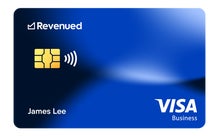
Revenued Business Card
Intro offer
N/A
Rewards Rate
N/A
Annual fee
None
Regular APR
Factor Based
2.7
Bankrate score

Remove a card to add another to compare
Remove a card to add another to compare
Revenued Business Card Overview
Combining a prepaid business card with a flexible spending line, the Revenued Business Card + Flex Line offers elements of both a business rewards card and a business loan or line of credit.
Because approvals are based on your business revenue and banking activity, the Revenued Flex Line makes capital available even if you have less-than-ideal personal or business credit scores. Revenued extends spending lines in exchange for a portion of your future business revenue, so you may gain access to more capital than you’d get with a typical subprime or secured card credit limit.
However, this financing model comes with risks. Not only is it impossible to avoid finance charges in the same way you can when using a traditional credit card’s grace period or a 0% introductory APR, but the card may require automatic daily or weekly repayments based on your projected sales. This requires you to pay close attention to your cash flow to avoid fees for missed payments due to insufficient fees. You may also be assessed fees if your account balance falls below a minimum amount set by Revenued during your repayment period.
-
Rewards
- This card does not offer rewards.
Expert Appraisal: Weak
See our expert analysis -
Rates and fees
- Annual fee: None
- Flex Line Charge: 10% to 50% of amount borrowed
- Regular APR: Factor Based
- Low balance fee: $35 per day
Expert Appraisal: Typical
See our expert analysis -
Other cardholder perks
- Quick application process
- Flex Line financing
- No hard credit inquiry
Expert Appraisal: Typical
See our expert analysis
Revenued Business Card pros and cons
Pros
-
Quick access to financing with limited documentation.
-
You may be able to access funding with bad credit if your business is profitable and shows positive cash flow.
Cons
-
High factor rates can make repayment expensive compared to what you might have to pay with credit card APRs in the short term.
-
Variable factor rates can make it difficult to plan repayment ahead of time.
-
Frequent repayments can make business cash flow management difficult.
Flex Line vs. traditional APR spending example
The biggest difference between the Revenued Business Card's Flex Line and a traditional interest rate is how repayment is determined. A factor rate is different from an interest rate and is presented to cardholders as a decimal rather than a percentage. Rates typically range between 1.1 and 1.5, which is essentially a 10% to 50% charge for access to funds. For example, if you make a $5,000 purchase with a factor rate of 1.1, then you’ll owe $5,000, plus $500 in finance charges over a repayment term set by Revenued (typically 4-18 months).
The following tables show how much interest or financing fees you’d face if you paid off a $1,000 balance on a credit card with an APR around the national average of 20% (based on Bankrate’s credit card payoff calculator), on a credit card at a 35% interest rate (as is common for poor or fair credit business cards), or on the Revenued Business Card + Flex Line.
Interest charges on $1,000 credit card balance (20% APR):
| 1 month | 2 months | 3 months | 12 months | 18 months |
|---|---|---|---|---|
| ~$16 | ~$25 | ~$33 | ~$111 | ~$165 |
Interest charges on $1,000 credit card balance (35% APR):
| 1 month | 2 months | 3 months | 12 months | 18 months |
|---|---|---|---|---|
| ~$29 | ~$43 | ~$58 | ~$199 | ~$299 |
Finance charges on $1,000 Revenued Card + Flex Line purchase:
| Factor rate | 1.1 | 1.3 | 1.5 |
|---|---|---|---|
| Total financing charge | $100 | $300 | $500 |
As you can see, the option that will be most affordable for you depends on a number of different factors, including the business credit card interest rates you can qualify for, the length of time you’ll need for repayment, and the factor rate you qualify for with Revenued.
For example, if you need to make a $1,000 purchase, qualify for a card with a 20% APR and can pay your balance within three months, you’ll pay less in interest than you would with Revenued’s lowest factor rate. However, if you can only qualify for a business card with a 35% APR and need to carry a $1,000 balance for more than a year, Revenued may be more affordable, depending on your factor rate.
Why you might want the Revenued Business Card
The Revenued Business Card + Flex Line could be a way for business owners — especially those with limited or damaged personal credit — to separate their business spending from their personal spending. The card’s simple application process may also allow you to access these funds sooner than with other cards.
Benefits: Quick application process and no hard inquiry
Once your Revenued Business Card + Flex Line application is reviewed, you’ll get an approval decision within an hour. You also aren’t required to move forward with opening an account until you see your spending limit and factor rate — a rare perk among credit cards.
Since your funding decision is based on revenue and cash flow — not your credit score — the Revenued Business Card + Flex Line can also be a good choice for cardholders with a limited or less-than-ideal credit history. And because the Revenued application does not require a hard credit inquiry, your credit score won’t drop temporarily, as it would if you applied for a typical business card.
Credit limit: Spending limit increases with your revenue
How much funding you’re eligible for is based on your current business savings, income, cash flow and debt, so your spending line evolves with them. This means as your business grows, so too will your Flex Line.
This can be helpful for business owners who are seeing rapid growth and continuously need more funding for their operations, but may not qualify for a large business loan or credit limit on a traditional credit card.
Why you might not want the Revenued Business Card
One of this card’s best traits is its low entry barrier when it comes to your credit score — a big perk if you have fair credit or limited credit history and need access to business funding. However, beyond this convenience, there are few perks on this card.
Rates: Flex Line can be expensive to use
On the surface, the card can seem pretty affordable. There’s no annual fee for this card, making it an accessible option for business owners who don’t have a lump sum of cash to tie up in fees. The Revenued Business Card also doesn’t come with a definitive APR since it is factor-based, so you don't have to worry about compounding interest charges.
However, to use your Flex Line, you’ll have to pay finance charges based on your factor rate, and funds are automatically deducted from your account based on your rate and payback term. You’ll also face fees if you don’t have enough money in your account or if your payment bounces ($35 for each day it’s assessed). Depending on the factor rate you qualify for, this option can be more expensive overall than traditional business credit cards.
Repayment terms: Can get you in trouble
Revenued’s Business Card and Flex Line share some common features with merchant cash advances (MCAs), a type of business financing where lenders provide a lump sum in exchange for a cut of your business’s future sales.
MCAs are notorious for their aggressive daily or weekly repayment schedules, which automatically deduct repayments until the principal and finance charges are repaid — and Revenued can work the same way, depending on the specific repayment terms set at the time of financing.
Frequent repayments can make it difficult for business owners to manage their cash flow and make needed purchases from incoming revenue. This, in turn, can lead to a cycle of dependence on business financing that can prove costly — even devastating — over time.
Benefits: Scarce for a business card
While the Revenued Business Card has some positive benefits for beginners, the long-term value is limited. Most of the card’s benefits are centered around the application and the Flex Line feature, along with the standard online dashboard and 24/7 customer service.
For business owners building their credit, this could be enough. However, for those looking for a card that includes better benefits, this card can be severely lacking. If you have good to excellent credit, it may be better to look at cards that offer business product discounts or travel credits.
Best cards to pair with the Revenued Business Card
It might be a good idea to pair this card with a no-annual-fee card that also earns rewards on purchases. While the Revenued Business card can help you access funding with a damaged or limited credit history, it’s not the most practical long-term credit-building option since you can’t avoid finance charges. A no-annual-fee card may prove less expensive and more efficient at building credit over time.
How the Revenued Business Card compares to other business cards
It’s hard to compare the Revenued Business Card + Flex Line because of its unique funding and payback structure, and because it shares very few features with traditional business cards.
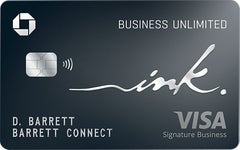
If you’re looking for a new business card, and you have fair or average credit, the Revenued Business Card + Flex Line may be one of your only options. But if you’re close to a good credit score, consider these alternatives:

Annual fee
Intro offer
Rewards rate
Recommended Credit Score
A FICO score/credit score is used to represent the creditworthiness of a person and may be one indicator to the credit type you are eligible for. However, credit score alone does not guarantee or imply approval for any financial product.
Annual fee
Intro offer
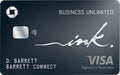
Earn $750 bonus cash back after you spend $6,000 on purchases in the first 3 months from account opening.
Rewards rate
Earn unlimited 1.5% cash back on every purchase made for your business.
Recommended Credit Score
A FICO score/credit score is used to represent the creditworthiness of a person and may be one indicator to the credit type you are eligible for. However, credit score alone does not guarantee or imply approval for any financial product.

Annual fee
Intro offer
Get a $1,000 Ramp card upon approval. Limit one per new customer. No minimum spend required.
Rewards rate
Up to 1.5% cashback on every purchase, with no limits or restrictions.
Recommended Credit Score
A FICO score/credit score is used to represent the creditworthiness of a person and may be one indicator to the credit type you are eligible for. However, credit score alone does not guarantee or imply approval for any financial product.
Is the Revenued Business Card right for me?
If you find that your business requires a little extra cash occasionally, the Revenued Business Card could be a good fit for you, as well as if you:
Need more flexibility financing your business.
Have bad or little credit history.
Would benefit from this card's unique Flex Line program, allowing you to finance sudden expenses without taking out a loan.
Alternative picks
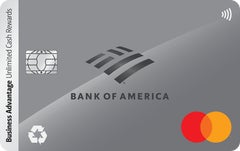
If you have a fair credit score or no credit history and can’t qualify for traditional business cards or a low-interest business loan, consider these other card options.


*The information about the Bank of America® Business Advantage Customized Cash Rewards Mastercard and Brex Card has been collected independently by Bankrate.com. The card details have not been reviewed or approved by the card issuer.
How we rated this card
Our proprietary card rating system takes into account a mix of factors when scoring business credit cards, including each card’s rewards rate, estimated annual earnings, APR, fees, perks and more.
We analyzed over 50 of the most popular business credit cards and scored each based on how its key features stacked up compared to those of other cards in its category.
Here are some of the key factors that gave this card its score:


* See the online application for details about terms and conditions for these offers. Every reasonable effort has been made to maintain accurate information. However all credit card information is presented without warranty. After you click on the offer you desire you will be directed to the credit card issuer's web site where you can review the terms and conditions for your selected offer.
Editorial Disclosure: Opinions expressed here are the author's alone, and have not been reviewed or approved by any advertiser. The information, including card rates and fees, is accurate as of the publish date. All products or services are presented without warranty. Check the bank’s website for the most current information.