First-time homebuyer guide



Key takeaways
- A first-time homebuyer is someone who has never owned a home or who has not owned a home in the last three years.
- Buying a new house involves many steps, from securing a mortgage to negotiating with sellers and navigating the underwriting process.
- First-time homebuyer programs offer mortgages with low down-payment requirements and other favorable terms or assistance.
What is a first-time homebuyer?
A first-time homebuyer is someone who has never owned a home before, or someone who hasn’t owned a home for at least the previous three years. In certain tax circumstances, the IRS considers someone who hasn’t owned a home in the prior two years a first-time buyer, as well.
44%
Step-by-step first-time homebuyer guide
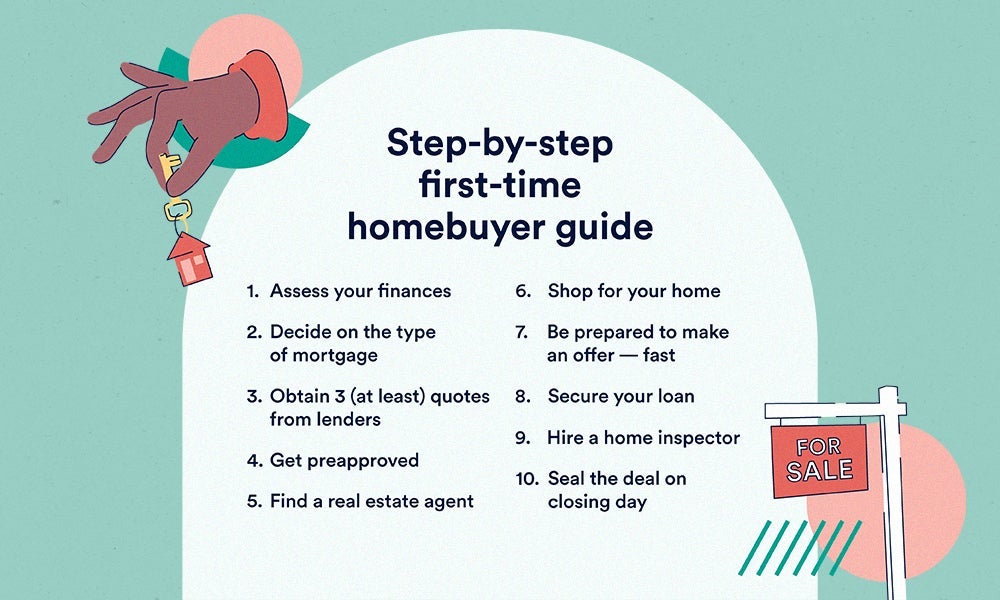
Step 1: Assess your finances
A home is the single biggest purchase most people make. If you can’t pay all cash, you’ll have to get a loan, so it’s important to ensure you’re in a good position financially to qualify for — and handle — a mortgage. Start by checking your credit report and score, examining your budget and assessing your ability to make a down payment and pay closing costs.
Credit
With a higher credit score — ideally, 760 or more — you’ll qualify for more favorable loan terms that could save you money over the life of your mortgage. That said, you can still get a loan with a score as low as 620 for a conventional loan or 500 for an FHA loan. You might not get the most attractive interest rate with that score, however, and might need a larger down payment.
Debt-to-income ratio
Calculate your debt-to-income (DTI) ratio. Depending on the type of mortgage you’re getting, the ideal amount to spend on housing costs — including the mortgage payment, property taxes and homeowners insurance — is 28 percent of your gross monthly income. For all of your monthly debt payments, including housing costs, the ideal amount is 36 percent.
For a conventional loan — the most popular kind of loan — many mortgage lenders look for a maximum 43 percent DTI ratio. But some lenders go higher, up to 50 percent, if you have other compensating factors, like a lot of money in savings. The higher your DTI ratio, the more likely you are to pay a higher mortgage rate.
Down payment
If you’re interested in a conventional loan and can put 20 percent down, you’ll avoid paying private mortgage insurance (PMI). This is an extra monthly fee that covers the lender should you default on, or stop paying, the loan.
You don’t have to put down 20 percent, though — you can pay as little as 3 percent with PMI. If you’re getting a VA loan or USDA loan, you likely won’t have to make any down payment. FHA loans, meanwhile, require a minimum of 3.5 percent down.
Savings
Closing costs can range from 2 percent to 5 percent of the home’s purchase price. There’s also the earnest money deposit, which is a smaller amount submitted with your initial offer to buy a home, usually 1 percent of the home’s purchase price.
Don’t forget: You’ll also want some savings lined up for moving expenses and furniture or possible repairs or updates you’d like to make to the home.
Along with ensuring you can qualify for a mortgage, a look at your finances will help you set a homebuying budget. There are many different ways of thinking about how much of your income should go toward a mortgage, but generally speaking, you’ll want to be sure you can comfortably pay for your housing costs and other recurring debts while still paying daily costs and — ideally — saving some money. Bankrate can help you decide how much house you can afford.
Step 2: Decide which type of mortgage to get
There are many types of mortgages. Besides choosing a loan type, you’ll also decide whether you want a fixed-rate or adjustable-rate mortgage and how long you want your loan term to be.
Types of mortgages
Examples of different kinds of mortgages include:
- Conventional loans: Conventional mortgages are the most common type of mortgage. A conventional mortgage isn’t backed by the U.S. government, and it comes with stricter qualifying criteria.
- FHA loans: An FHA mortgage is a government-backed loan insured by the Federal Housing Administration (FHA). These loans come with lower credit score requirements, as low as 500 with a 10 percent down payment.
- USDA loans: Like FHA loans, a USDA mortgage is a government-backed mortgage. These types of mortgages are designed for borrowers in eligible rural areas and do not require a down payment.
- VA loans: A VA loan is guaranteed by the U.S. Department of Veterans Affairs. These mortgages are available to eligible veterans, active-duty service members and surviving spouses and generally don’t require any money down.
Fixed or adjustable rate
Fixed-rate loans tend to have slightly higher rates, but the rate never changes. An adjustable-rate mortgage (ARM) typically starts with a lower rate for a set time — such as five or seven years — and then adjusts up or down based on prevailing rates at a predetermined interval, such as once every six months. If mortgage rates are up, your personal rate will increase, and so will your monthly payment.
Fixed-rate mortgages are more common and are generally easier to get. They offer a more predictable payment long-term and have simpler eligibility criteria than an ARM. However, if you’re savvy and meet the financial requirements — and you also plan to move or refinance before the rate adjusts — an ARM could save you some money in the short-term. The caveat is that it comes with risk. For many people, you will need to be able to sell or refinance for an ARM to make financial sense.
Loan terms
Also consider your loan term, such as 15 or 30 years. Shorter-term loans have lower rates but larger monthly payments. This means less flexibility in your monthly budget in exchange for lower overall borrowing costs. Most first-time homebuyers get a 30-year, fixed-rate mortgage.
Step 3: Get quotes from at least three mortgage lenders
Comparing mortgage loan offers is one of the essential steps to buying a house. Aim to get rate quotes from at least three lenders, as mortgage interest rates vary considerably and change often.
Some lenders offer rate quotes online after you enter your contact info and financial details. Other lenders will require you to hop on the phone for a quick conversation. When comparing these rate quotes, take into account the fees that come with the loan. For instance, one loan may have a lower interest rate, but it requires you to buy points upfront to lower the rate. Always use the annual percentage rate (APR) to compare loans, because the APR factors in the cost of fees.
While some lenders refer to this step as prequalification, don’t get it confused with preapproval. Prequalification allows you to get an estimated rate and understand how much you can afford. The rate and fees you’ll pay are a best guess based on the limited financial info you give to a mortgage lender. When you go to get preapproved, you’ll need to submit more documentation and submit to a credit check.
For 2026 so far, rates for 30-year fixed-rate mortgages have been between 6% and 6.5%. It’s expected that rates will stay in this range throughout the year. However, rates offered on Bankrate are much lower than average. As of April 1, the top offer on Bankrate is 5.86%.
Step 4: Get preapproved for a mortgage
When you’re ready to search for a home and make offers, get preapproved for a mortgage. A preapproval is a written, preliminary commitment from a lender to loan you a certain amount of money at a certain rate. It is not a finalized offer. However, a preapproval letter is crucial when you’re shopping for a home because it shows sellers you’re likely able to finance the purchase.
To get preapproval for a mortgage, you’ll need to provide a variety of documents and personal financial information including:
- Bank statements and pay stubs from at least the past two months
- Federal tax returns from the past two years
- Employer contact information
- Business records if self-employed
- Statements from retirement and investment accounts
Keep in mind: While quotes can be a valuable means of comparison, your rate won’t be finalized until you lock it in with the lender.
Step 5: Find a real estate agent
Once you’re preapproved and ready to start looking for homes, connect with a real estate agent who has experience with homebuyers in your area. Ask family or friends for a recommendation, or research agents online. Bear in mind, some might specialize in working with sellers instead of buyers.
Keep in mind, too, that you don’t have to sign a contract with the first agent you meet. Interview a few, and ask about their experience, track record and whether they specialize in any particular type of residence, such as condos. Make sure you understand their communication style — will you hear from them every day with new listings? — and ask for references. Ideally, the agent should know the local housing market well and be able to provide valuable insights about things like neighborhoods and school districts.

Help us shape the future of personal finance
We’re building something new to make rate shopping smarter and simpler. Join our waitlist to get early access, share your feedback, and unlock exclusive offers.
Priority rate alerts
Exclusive member offers
Time saving
Limited spots remaining
You're signed up!
Now, help us personalize your experience. Answering the next few questions will ensure you receive the most relevant tips and offers.
What are you looking for?
Tell us which products you are in the market for
What do you already have?
Tell us which products you already have
Tell us a bit more about you.
Are you a homeowner?
Tell us about your financial situation
What is your FICO credit score
One more thing
What is your annual income?
Stay tuned to see what we're building
You're all set! We're gearing up to share something big. You'll hear from us soon with what's next.
Step 6: Shop for a home
As you view listings on real estate websites, talk to your agent about your budget and top requirements so they can send you listings, too. Your home search will largely be defined by your unique needs, but you should always keep in mind:
- Location: Location is the one thing you cannot change about a home. Before making an offer, think about the neighborhood, the school district, potential noise pollution and if the home is located in a flood zone, for example.
- Condition: Review each home with a critical eye, assessing it for any signs of damage or potential expensive repairs.
View several homes before making a decision to get a clearer picture of the options available and to nail down what you like and don’t like — and need or don’t need.
Step 7: Make an offer
When you’re ready to make an offer on a home, discuss the terms of the purchase agreement with your agent. They’ll analyze comparable listings (“comps”) recently sold in the area to help you make a competitive offer. The purchase agreement typically includes an offer price, a deadline for the seller to respond — usually within 24 to 48 hours — and any contingencies.
At a minimum, the offer should include appraisal and home inspection contingencies. That means if the home appraises under the offer price or an inspection reveals significant issues, you can walk away without losing your deposit. If a bidding war seems likely, the offer should also include an escalation clause with your top offer limit.
The seller can accept, reject or counter at a different price. Tap your agent’s experience to negotiate with the seller for the best possible outcome. It’s not uncommon for homes to sell quickly or above the list price, so don’t panic if you don’t get the first home you place an offer on.
Step 8: Apply for a mortgage
If the seller accepts your offer, it’s time to apply for your mortgage. This isn’t the same process as getting preapproved, but they are similar. Here are our in-depth guides to the loan application:
Mortgage applications
What’s included and tips to prepare.

How to read mortgage loan estimates
A loan estimate is a standard, three-page document from a lender.

What is mortgage underwriting?
Mortgage lenders use a process called underwriting to approve you.

Mortgage questions to expect
Here are some common mortgage questions to expect from a lender.
Step 9: Hire a home inspector
After your offer is accepted, hire a home inspector to evaluate the property. Your agent can recommend one, or you can locate one through the American Society of Home Inspectors, the International Association of Certified Home Inspectors or the National Academy of Building Inspection Engineers. As you did when researching real estate agents, consult online resources to check for complaints and read testimonials.
Keep in mind: Your real estate agent may refer an inspector. While this isn’t always problematic, it can be. The inspector may feel pressured to give a less-than-accurate report so the sale stays on track. It may be best for everyone to work with someone your agent doesn’t know.
An inspector will check the home’s foundation, roof, HVAC, plumbing and electrical systems but typically will not check for the presence of lead paint or mold. The inspection can take about two or three hours and range from $300 to $500, depending on the home’s size and the extent of the inspection. You and your agent should be present so you can ask for clarification on any issues.
If the inspection report uncovers major problems, you could ask the seller to fix them, but he or she might not be willing if there are other offers that won’t require them to pay for repairs. If you have an inspection contingency in your purchase agreement, and the seller is unwilling to address the issues, you might choose to walk away instead.
Step 10: Get homeowners insurance, finalize your move and close
Once the inspection is handled, your mortgage lender might conditionally approve your loan. This typically means the lender is waiting to resolve a few details or for other contingencies to be met before clearing the loan to close. At this point, the next steps usually include:
Insuring the house
Mortgage lenders require homeowners insurance, which helps protect your — and their — investment. Insurance premiums vary, so get quotes from several companies or work with an insurance broker who can shop rates for you. Assess your needs and ensure you buy enough coverage to completely rebuild your home if it’s destroyed or seriously damaged. If your home is located in a federally designated flood zone, you’ll need to buy flood insurance, too.
Planning your move
Depending on how quickly you plan to move, you’ll likely want to start planning before the closing. As you prepare for move-in day, contact your utility, cable and internet providers to arrange new service for your move-in date.
Closing
Finally, it’s time to put pen to paper and close on your new house. The closing process is when you finalize the purchase contract and officially become a homeowner. If you’re paying closing costs on closing day — and most buyers do — follow your escrow company or settlement agent or attorney’s payment instructions very carefully. If you receive an email with wiring instructions, call your settlement agent first to verify it’s legitimate.
A day or two before the closing, you’ll do a final walkthrough of the property to make sure repairs, if any, were made and that the home is vacant. At the closing table, you’ll sign paperwork to finalize the loan and transfer ownership of the home from the seller to you.
Help for first-time homebuyers
- First-time homebuyer programs: If you’re a first-time homebuyer, you might qualify for assistance affording the home. Some lenders offer a mix of slightly discounted mortgage rates, minimal fees and low- or no-down payment options for qualifying buyers. Many states and local governments also have programs that offer down payment or closing cost assistance — either low-interest-rate loans, deferred loans or even grants.
- Mortgage credit certificates: If eligible, you might also benefit from a mortgage credit certificate (MCC). An MCC offers a dollar-for-dollar federal tax credit, up to $2,000 per year.
Challenges of being a first-time homebuyer
Buying your first home isn’t without challenges. Be ready to:
- Have lots of liquidity: As a first-time homebuyer, you’re not moving from one property you own to another, so you won’t have the proceeds from a home sale to use in a pinch.
- Explain your credit and financial circumstances: As a first-time buyer, you might have a short credit history, plan to use gift funds for a down payment or earn income through a gig work or another form of self-employment. These aren’t dealbreakers to getting a mortgage, but you’ll need to be able to prove you still qualify you for a loan. Be prepared for the mortgage lender to ask — and potentially ask again — for lots of documentation.
- Pay for ongoing costs: Budgeting for home maintenance costs is one of the biggest transitions from renting to owning, so make sure you plan accordingly. The average annual cost of owning and maintaining a single-family home is more than $18,000 a year, according to Bankrate’s 2024 Hidden Costs of Homeownership Study.
- Prepaid mortgage expenses: Also known as prepaids, these typically include your annual homeowners insurance premium, property taxes for the coming year and mortgage interest that accrued during the closing process. Generally, you’ll pay these at the same time you pay the rest of your closing costs.
Why we ask for feedback Your feedback helps us improve our content and services. It takes less than a minute to complete.
Your responses are anonymous and will only be used for improving our website.

Up next




We appreciate your feedback
Thank you for taking the time to share your experience.