Guide to no-down-payment mortgages: Am I eligible?


Key takeaways
- A no-down-payment mortgage allows you to finance 100 percent of your home, but you’ll likely still have to pay closing costs — or roll them into your mortgage.
- VA loans and USDA loans don’t typically require a down payment.
- If you don’t qualify for a no-down-payment mortgage, consider loans with low down payments, including conventional or FHA loans, or apply for down payment assistance.
What is a no-down-payment mortgage?
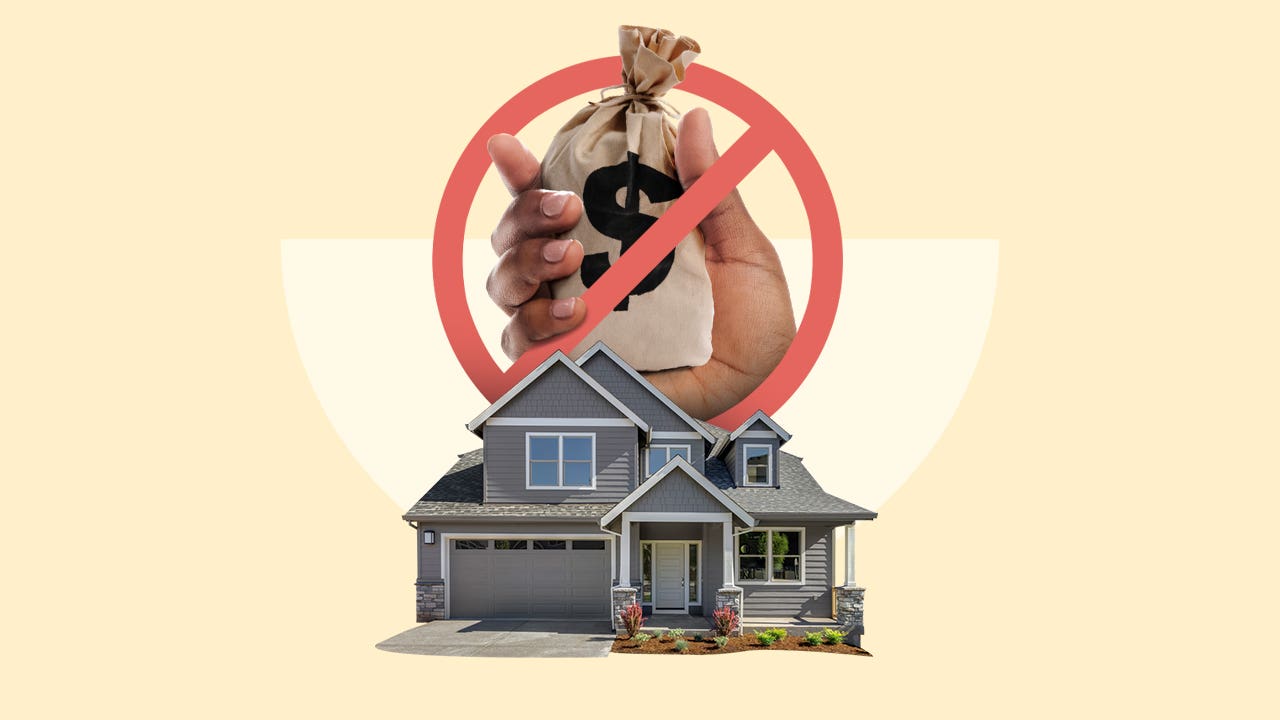
A no-down-payment mortgage doesn’t require you to make a down payment at closing. With rising home prices, it’s more and more difficult for many buyers to save up for the upfront costs of homeownership. No-down-payment loans eliminate one of the biggest upfront costs.
One-fifth (20 percent) of aspiring homeowners believe they won’t ever be able to save enough for a down payment on a house, according to Bankrate’s 2025 Home Affordability Report.
No-money-down mortgage options
The two most prominent no-down-payment mortgages are VA and USDA loans.
VA loans
If you’re a military service member, veteran or surviving spouse, you might qualify for a VA loan guaranteed by the U.S. Department of Veterans Affairs (VA). Unlike a conventional loan, VA loans don’t typically require a down payment, and they don’t charge mortgage insurance.
However, you will pay a funding fee, either at closing or by financing it into your mortgage. This fee ranges from 1.25 percent to 3.3 percent of the loan amount, and it varies depending on your down payment size and whether you’ve used a VA loan before. Those who don’t make a down payment, as well as repeat VA loan applicants, pay higher funding fees.
USDA loans
The U.S. Department of Agriculture (USDA) guarantees USDA home loans for lower- to moderate-income buyers purchasing homes in eligible rural areas. These loans don’t require a down payment, but there’s an upfront fee — also known as a guarantee fee — of 1 percent of the principal loan amount which can be financed into the mortgage.
On top of that, there’s an annual fee of 0.35 percent of the loan amount which lasts for the life of the loan. The only way to remove this annual fee is to refinance to a non-USDA loan.
Other zero-down mortgage options
- New York-based Sunmark Credit Union offers a no-down-payment option — known as a Dream Bigger mortgage — without permanent mortgage insurance.
- If you’re in the medical field and have school debt, you may qualify for a no-down-payment physician mortgage. These allow higher debt-to-income DTI ratios, provided you have the income to afford monthly payments.
- Most loan types allow gift funds as part of the down payment — or the whole thing. If you have a family member or friend willing to give you money toward your home, you may be able to avoid putting money down.
Low-down-payment mortgage options
If you aren’t eligible for a true no-money-down home loan, you might still qualify for a low-down-payment mortgage.
3 percent conventional loans
Fannie Mae and Freddie Mac — the two government-sponsored enterprises underpinning mortgages in the U.S. — back several 3-percent-down conventional loan programs:
- Conventional 97
- HomeReady
- Home Possible
- HomeOne
You will be required to pay for private mortgage insurance (PMI). PMI varies in cost depending on your down payment amount and credit score. Once you reach 80 percent loan-to-value (LTV) on your home, you can request the lender remove PMI. Otherwise, it will automatically come off once you reach 78 percent LTV.
FHA loans
Insured by the Federal Housing Administration (FHA), an FHA loan requires only 3.5 percent down with a credit score as low as 580. If you have a credit score between 500 and 579, you’ll need to put 10 percent down.
Similar to PMI, you’ll pay FHA mortgage insurance with an FHA loan. However, unlike conventional PMI, you’ll pay both an upfront mortgage insurance premium (MIP) at closing and an annual MIP split up between your monthly payments. The upfront MIP equals 1.75 percent of your loan amount, and the annual MIP varies depending on your down payment and other factors. If you make a down payment of 10 percent or more, you’ll pay the annual MIP for 11 years. Otherwise, you’ll pay it for the life of the loan.
1-percent-down mortgage programs
Some mortgage lenders offer conventional mortgage programs that require only 1 percent down, including Rocket Mortgage’s ONE+ program. In this case, the lender pays 2 percent of the required 3 percent down payment for a HomeReady or Home Possible loan, and you need only provide the remaining 1 percent.
Good Neighbor Next Door
The Good Neighbor Next Door (GNND) program is for borrowers who work in select public service professions — teachers, firefighters, law enforcement and emergency medical technicians — and plan to buy a home in a qualifying area. Sponsored by the U.S. Department of Housing and Urban Development (HUD), the program provides a discount of up to 50 percent on the list price of a qualifying home.
Pros and cons of a no-down-payment mortgage
The ability to buy a home with no or very little money down can be appealing, but there are drawbacks, too.
Pros of no-down payment mortgages
- You can buy a home now instead of later. When you don’t have to come up with a substantial down payment, it’s easier to buy a home sooner.
- You can keep more cash on hand. Even if you have enough to make a sizable down payment, you might want to keep that money liquid for things like emergency savings, remodeling or investing.
Cons of no-down payment mortgages
- You’ll have no or little equity. Home equity is the portion of your home that isn’t financed by a mortgage. When you start with a low- or zero-down loan, you’ll have little to no equity. If home values fall, you could end up owing more on the home than it’s worth, making it difficult to sell or refinance.
- Your interest rate might be higher. You might pay a higher interest rate for a no- or low-money down loan. That’s because with less money tied up in the home, a mortgage lender might view you as more of a risk. Of course, the higher your interest rate, the more you’ll pay overall.
- You’ll need a bigger mortgage. The less you put down, the more you’ll need to borrow, which means you’ll pay more in interest over the life of the loan, and have a larger monthly payment.
- You’ll pay fees. Both VA and USDA loans come with fees, which add to the cost of the loan.
Should you get a no-down-payment mortgage?
If it's the only way you can become a homeowner, then proceed.— Jeff Ostrowski, Housing Market Analyst at Bankrate
“Even if you can get a zero-down loan, should you? That depends,” says Jeff Ostrowski, housing market analyst at Bankrate. “If it’s the only way you can become a homeowner, then proceed. But I’d keep local market conditions in mind. If you’re in a place where home prices are still rising, a no-down-payment loan can be a good move. If you’re in one of the regions where values are falling, you could be underwater in a year.”
No-down-payment mortgages are geared toward buyers with limited savings who want an accessible way to own a home. While they’re a great option for those who qualify, they also come with extra fees. You’ll pay less for your loan over time if you can afford to make a down payment.
FAQ
Why we ask for feedback Your feedback helps us improve our content and services. It takes less than a minute to complete.
Your responses are anonymous and will only be used for improving our website.