How to start (and build) an emergency fund



Key takeaways
- An emergency fund helps ensure you can handle unplanned expenses, whether from a job loss or a substantial car repair or medical bill.
- Saving three to six months’ worth of essential expenses is often recommended, but individual circumstances may require saving more or less.
- Automating savings and using strategies including budgeting and saving windfalls (such as a tax refund or bonus) can help you start, grow or rebuild your emergency fund over time.
An emergency fund can be a financial lifesaver if you find yourself unemployed or you have unplanned expenses such as a large medical bill or a car repair. To start and build your emergency fund, determine your goal amount, automate your saving, find ways to increase your savings, and consider which type of account is best to store your funds.
Some experts recommend that your emergency fund includes three to six months’ worth of living expenses. However, only 46% of U.S. adults have enough to cover three months of expenses — and 24% have no emergency savings at all — Bankrate’s latest Emergency Savings Report found.
Having a healthy emergency fund helps you breathe easier, knowing you can handle life’s curveballs without going into debt. Here’s how you can start building up this financial safety net today.
What is an emergency fund?
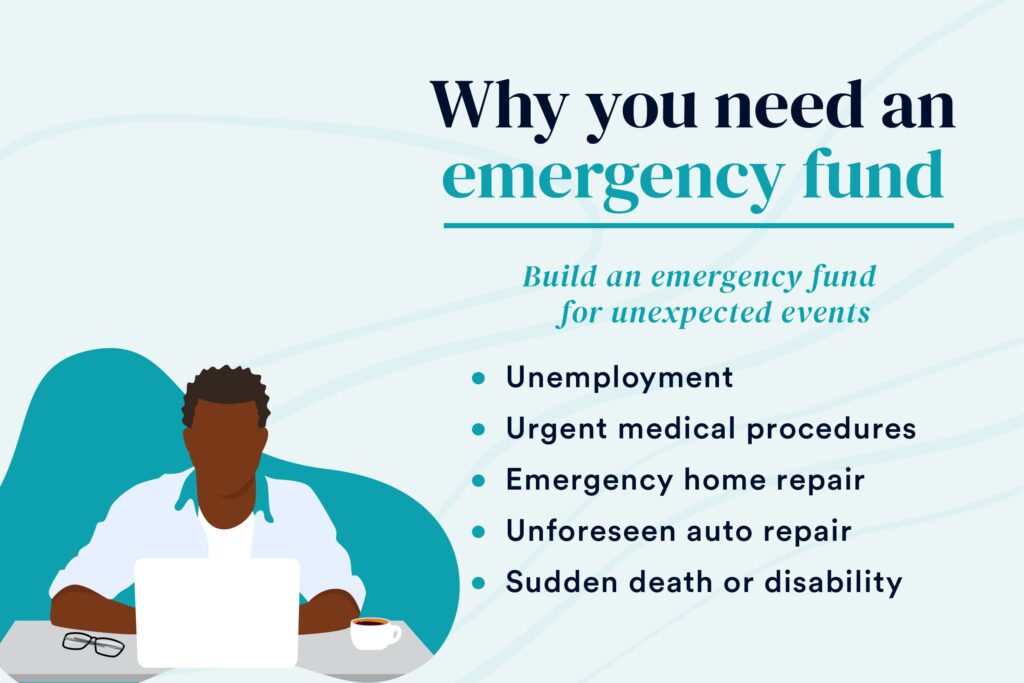
An emergency fund is money in a bank account that’s set aside for unplanned expenses, such as an unanticipated dental or medical bill or home or auto repairs. An emergency fund can also help you weather decrease in income from job loss or extended illness.
Serving as a financial cushion, an emergency fund helps you handle life’s curveballs without going into debt. It reduces the need to rely on high-interest credit cards or costly personal loans to pay for sudden expenses.
If hit with an unplanned $1,000 expense, 41% of people would pay it with their savings, compared with 25% who would pay with a credit card, 13% who would pay it but have to cut other spending, 13% who would borrow from family or friends and 5% who would take a personal loan.
The findings reaffirm the need for households to have a well-funded emergency fund, and that it’s never too soon to start saving for an emergency.
7 steps to build your emergency fund
1. Determine how much you should save in an emergency fund.
Some experts recommend you save three to six months’ worth of expenses for emergencies. However, the amount you need for emergency savings can vary based on your own financial situation. Factors to consider include how stable your income is, your level of risk tolerance and whether you have children or other dependents.
Having a budget can help when determining the right amount for your emergency savings. Once you know the amount you spend every month, you can multiply that by a set number of months to decide how much to keep in an emergency fund.
For example, the average household spent $78,535 on living expenses in 2024, according to the most recent data from the U.S. Bureau of Labor Statistics. That amount breaks down to $6,545 per month. For an emergency fund, a household that spends this much should save between $19,635 and $39,270. Your number may be above or below this range, depending on your budget.

“The more unstable your income is, the more you should probably keep in an emergency fund. Also, the higher your insurance deductibles are, the more you should be keeping in an emergency fund. A family that has two stable incomes and no kids needs much less in emergency savings than a single-income household with four kids.”— Erik M. Baskin, founder of Baskin Financial Planning in Colorado Springs, Colorado
| Situations requiring MORE savings | Situations allowing LESS savings |
|---|---|
| Unstable income: Freelancers and gig workers may need extra savings to cover expenses during slow months | Minimal expenses: If you don’t have major monthly costs like a mortgage or car payment, a smaller fund may be sufficient |
| Self-employment: Business owners may face unpredictable cash flow or irregular income | No dependents: With fewer financial obligations, you may not need to save as much for unexpected emergencies |
| High insurance deductibles: Significant out-of-pocket costs for medical care, auto repairs or home emergencies | Focused on debt payoff: If you have high-interest credit card debt, prioritizing a smaller emergency savings while tackling debt can save money |
| Nearing retirement: Retirees relying on investments may need more cash to avoid withdrawing funds during market downturns | Other safety nets: Access to additional resources like a partner’s income, family support or other income streams |
| Supporting dependents: Caring for children or elderly parents requires extra protection against unexpected costs |
The danger of overfunding your emergency savings
While a well-funded emergency savings account provides peace of mind, keeping too much cash in savings can limit your financial growth. Excess savings may be put to better use, in some cases, by paying down high-interest credit card debt. This will reduce monthly expenses and save money on interest.
You could also devote surplus funds into a retirement account or diversified investment portfolio. While such investment products carry more risk than savings accounts, they can afford the opportunity to earn a higher return. One way many Americans invest is through a 401(k) retirement plan, and many employers match contributions up to a set percentage.
To avoid overfunding, review your savings regularly and adjust as your expenses change. Once you’ve saved enough to fund your emergency savings, consider redirecting extra cash toward financial goals that build long-term wealth or reduce future financial burdens.
2. Make a budget and see where you can start saving more money
To find ways to save, you first have to understand where and how you spend. Budgeting helps you distribute your income more efficiently and find ways to reduce or manage your spending.
A budget can allow you to allocate what you’re devoting to your saving versus spending. You can try to determine where to cut spending (or increase your income) to reach your savings goals.
3. Decide where to keep your emergency fund
The best place to keep your emergency fund is in a high-yield savings account, which offers easy access and pays a competitive yield. This is because these accounts offer easy access to your cash (unlike certificates of deposits (CDs) and investments) when you need it most.
A high-yield savings account will also earn a variable interest rate, which means your money will grow. Look for banks and credit unions that insure deposits through the Federal Deposit Insurance Corp. (FDIC) or the National Credit Union Administration (NCUA).
The best high-yield savings account rates are often from online-only banks or credit unions. These also commonly charge either no fees or fees that are lower than those of brick-and-mortar banks.
If you prefer to keep some cash at home in case of an emergency, a good place to store this is a locked, waterproof and fireproof safe. Ultimately, the best place for the bulk of your liquid funds is a high-yield savings account at an FDIC-insured bank or NCUA-insured credit union.
Money tip: Consider keeping your emergency fund in an FDIC-insured online savings account, which typically pays more interest and comes with fewer fees than those from brick-and-mortar banks. But keep in mind that transferring funds from your savings account to your checking account can take a few days in some instances.
4. Automate your savings
Direct deposit automatically places your paycheck into your checking or savings account. This eliminates the need to manually deposit checks. But all your funds don’t have to go into one account.
Setting up a split direct deposit allows you to put a set amount of money into your emergency fund with the remainder going to your checking account — or vice versa.
Automating the process not only simplifies saving, it can also help keep you on track toward your savings goals. If that money is automatically routed to a separate account, there’s less temptation to spend it.
For additional savings on autopilot, consider finding a checking account that lets you round up your debit purchases to the nearest dollar and transfer that money to a savings account automatically. For example, Bank of America offers such a “Keep the Change” feature to customers with checking and savings accounts with the bank.
5. Gradually increase your savings
One way you can boost your savings rate over time is to increase the amount you’re contributing to your emergency fund by 1% or a specific sum, until you’ve reached your savings goal. Increasing the amount in increments can help to make the larger deposit to your savings account appear less noticeable.
“The best way to build up emergency fund savings when cash flow is tight is to take tiny steps that add up over time,” says Noah Damsky, a chartered financial analyst and founder of Marina Wealth Advisors. “If you want to save $150 per month, save $5 per day. Not only is it less daunting, but it helps you realize how you can reach your goals by making small sacrifices,” he adds.
6. Save unexpected and extra income
Unexpected money can come in the form of a tax refund, bonus, cash gift or, inheritance.
These financial windfalls can be a great win for your emergency fund account, so consider allotting at least part of the unexpected income to savings. You’ll want to do so before you start spending the money since you can easily overspend and end up with less savings than you intended.
You can also work to increase your income. You can do this by talking to your manager about what you could do to get a raise, take on extra hours, explore a side gig or freelance work or sell your unwanted items.
7. Keep saving after reaching your goal
The more you can add to your emergency savings, the longer you’ll be able to stay afloat if you end up out of work due to a job loss or illness. Some emergencies require more than a six-month cushion. Being unemployed for more than a year or being hospitalized for several months are both situations where you’ll be glad you have more money saved in your emergency fund.
You’ll also want to think about large, unexpected expenses that could cost more, such as making a large house repair or buying a car. You can work to save up for these emergencies in addition to covering a few months’ worth of living expenses.
How to balance saving for an emergency with other saving goals
In addition to saving for emergencies, you may wish to save for other goals such as saving for retirement, a wedding, a down payment on a home or a vacation. With a budget in place, you can determine how much to devote from each paycheck to multiple such goals. While emergency savings should be a top priority, you may be comfortable setting aside additional funds for other purposes.
Some savings accounts can help with the process by allowing you to set up customizable savings buckets or categories. An example is the high-yield savings account from Ally Bank, which lets you create buckets for each goal. What’s more, having such buckets can offer you the flexibility of pulling from a lower-priority bucket should a financial emergency arise.
“The beauty of saving into a high-yield savings account is that they can almost do double duty,” says Baskin of Baskin Financial Planning. “If we save $10,000 for a vacation next year, those funds can also be used in the event of emergency,” he says, adding you may decide to take from that vacation bucket for “the water heater that goes out next week.”
When to use your emergency fund
Your emergency fund is designed to protect you from financial hardship, but it’s important to reserve it for true emergencies. Here are common situations when using your emergency savings can be a smart move:
- Job loss or reduced income: If you’re laid off, furloughed or experience a reduction in work hours, your emergency fund can help cover essential living expenses such as rent, utilities and groceries.
- Unexpected medical expenses: Emergency funds can cover medical bills, co-pays and deductibles not fully covered by insurance, especially for urgent care or necessary procedures. And if you’re a pet owner, don’t forget about unexpected trips to the vet and medication.
- Major home repairs: Urgent home repairs, including fixing a broken furnace or roof leak, are valid reasons to dip into your emergency fund to prevent further damage or higher repair costs.
- Car repairs: If your vehicle requires emergency repairs to remain in use and safe, your emergency fund can help you avoid taking on debt for the expense.
- Family emergencies: Emergency savings can cover expenses related to unexpected events such as a funeral or urgent family-related travel.
When not to spend your emergency fund
It’s tempting to dip into your emergency fund when unexpected expenses pop up, but not every unplanned cost qualifies as an emergency. Here are common expenses that shouldn’t be covered with emergency savings:
- Impulse and non-essential purchases: Can’t-miss sales at your favorite retailer or items such as electronics, toys, clothing or home goods may feel urgent but are better off being paid with budgeted funds.
- Vacations and leisure activities: Travel and entertainment should be saved for separately, and not paid for with emergency funds. The same is true for upcoming events, such as a family member’s wedding.
- Debt payments: While paying off debt is important, using emergency savings for credit card bills or personal loans could leave you vulnerable when true emergencies arise.
- Non-essential home upgrades: Upgrading kitchen appliances, redecorating or making enhancements to your home aren’t emergency-level expenses.
- Investments: Investing in the stock market or other speculative ventures carries potential financial risks. Your emergency fund should remain safe, accessible and free from market volatility.
How to build a medical emergency fund
Medical expenses can be quite costly, and even if you have health insurance, you may need to spend thousands of dollars each year in out-of-pocket expenses. What’s more, around 8% of Americans had no health insurance in 2024, according to the most recent data from the U.S. Census Bureau.
Having enough money set aside to handle unplanned medical expenses can help keep you from going into debt the next time you find yourself in need of a medical procedure or a trip to the emergency room.
One way you may be able to save for medical expenses is a health savings account (HSA). These accounts allow those with a qualifying high-deductible health plan to save pre-tax money and use it for approved medical expenses.
What to do if you don’t have an emergency fund
Not having any money saved for emergencies can be a significant source of stress — and one that many Americans are feeling. Among people whose mental health is negatively affected by money, 57% cited not having enough emergency savings, according to Bankrate’s Money and Mental Health Survey.
If you have no emergency savings and find yourself on the edge of financial disaster, some options to consider include:
- Filing for unemployment if you’ve recently lost your job
- Contacting your credit card and utility companies to see if you can negotiate lower monthly payments or create a more manageable payment plan
- Pausing or canceling certain recurring credit card charges, such as unnecessary subscriptions or memberships
- Taking on work opportunities that may pay quickly, such as food delivery or dog walking
- Selling unused items on online marketplaces such as eBay, Etsy, Poshmark or Facebook Marketplace
- Applying for government food assistance programs
Bottom line
Starting and keeping an emergency fund is crucial for financial stability and peace of mind. It can help cover unexpected expenses and prevent the need for high-interest credit cards or loans.
Aim to save three to six months’ worth of living expenses and consider automating your savings through direct deposit. Start small and make it a priority to build your emergency fund, as it can make all the difference in times of financial uncertainty.
Emergency Fund FAQs
Why we ask for feedback Your feedback helps us improve our content and services. It takes less than a minute to complete.
Your responses are anonymous and will only be used for improving our website.

You may also like

8 simple habits to grow long-term wealth