Home > Credit Cards >

No signature required

When credit cards first arrived on the scene, they were often used to buy big-ticket items, such as furniture, appliances and tools. Eventually, they made their way down the retailer food chain and became popular in malls and clothing stores, and now you can even buy groceries and booze using your credit card.

But it's always been a hassle to use a credit card for payments of less than $25, making it difficult to use your credit card at places such as fast food restaurants or convenience stores.

- advertisement -

Times are changing quickly, though, thanks to the efforts of credit card companies, which have worked with retailers to introduce new technologies and processes designed to speed up the pace of transactions and make it easier for consumers to use their credit cards while still protecting them from fraud.

One swipe and you're done
MasterCard recently introduced its Quick Payment Service (QPS), which is essentially a policy change that allows merchants to process low-priced transactions without requiring a signature from a consumer.

It's based on a floor price depending on the type of industry: $25 at convenience stores and fast food restaurants, $35 at drug stores and movie theatres and $50 at parking garages and service stations. Nagesh Devata, vice-president of acceptance development and product solutions at MasterCard Canada Inc., in Toronto, says more than 20,000 merchants have enrolled in QPS since its launch.

The simple process change makes buying something a two-step transaction compared to the five steps it used to take to use a credit card and the six steps it used to take for a debit card. Now, the card is simply swiped and handed back to the consumer. Before, there would be a swipe, a wait for an authorization, the printing of a receipt, the signing procedure and the handing back of the card. "Overall, what we are doing is making the checkout process more efficient," explains Devata.

Visa has a similar policy. Mike Bradley, vice-president, new products and platforms, for Visa, in Toronto, says the company has also introduced a "no-signature-required policy," for the small-payment segment covering fast-food restaurants, video stores and parking garages. "The card holder doesn't have to sign," so there's no "fumbling around for pens and messing around with paper," he says. It also means retailers don't have the same administrative headaches and no longer have to file a paper receipt of the transaction with a signature.

Fraud protection
It's the signature that has traditionally been used to ferret out fraudulent transactions after the fact. But don't worry; if your credit card is somehow used without your authorization, you'll be reimbursed. "Customers are protected with zero liability. Cardholders are never truly responsible for fraud," says Bradley.

MasterCard also has a zero-liability policy for unauthorized purchases. However, if one appears on your statement, you have to report it immediately and then deal with the bank that issued the card to satisfy its officials that the card was improperly used in order to be reimbursed.

It's not just policies that are changing to speed up the payment process. New technologies are also finding their way into the cards themselves, which makes it faster and easier for merchants to process transactions.

New technology makes cards safer and quicker to use
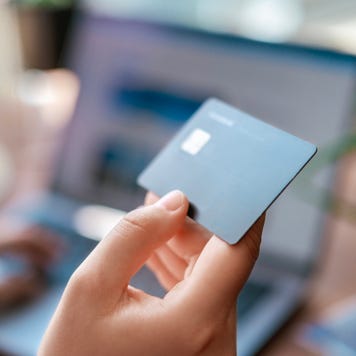
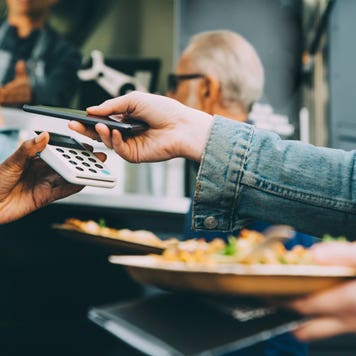
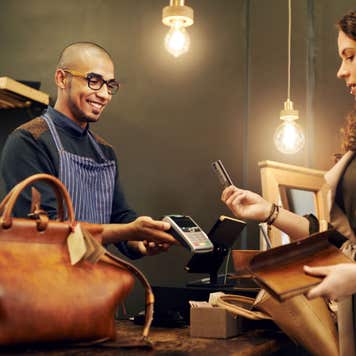
MasterCard recently rolled out PayPass, what it calls a "contactless" payment service. Instead of swiping your credit card through a card reader, you simply tap it against a terminal. The card never leaves your hand, which provides added safety.

A computer chip and radio frequency antenna in the card technology transmits the payment information quickly and securely. The transaction is processed and a receipt is issued in no time at all, unless the payment qualifies under the QPS system as a small-ticket item, for which no receipt is required.

MasterCard has found that PayPass results in an eight-per cent improvement in the speed of a transaction and has increased the size of transactions by 10 per cent compared to the typical cash transaction. It also reduces the need to handle cash. "Contactless payments are a fast, convenient alternative to cash. It saves time. Merchants no longer have to handle the card, they can simply focus on serving their customers," says Devata.

VISA is taking a slightly different track with computer chips and cards. Bradley says chip technology will allow credit card companies to move away from signatures and toward PIN-based transactions, in which the consumer authorizes a payment by inputting his personal identity number. All Visa credit cards issued in 2007-08 will have computer chips on them, eliminating the need for signatures and allowing someone to simply enter their PIN to approve the transaction, similar to a debit card. That's faster than signing and printing a receipt, and it's also safer, he says. It's virtually impossible to copy such cards and they can only be used with the user's PIN, making it a two-step security process.

Technology is also having an impact even when signatures are required. Many merchants now capture signatures electronically. For example, one U.S. grocery chain has a computer tablet that consumers simply sign after their cards are swiped, which completes the transaction and allows the merchant to handle the administration end of credit card business more efficiently.

But the real future lies in wireless technologies and using things like cell phones to complete transactions. In some parts of the world, for example, pointing your cell phone at a pop machine and buying a soda is already a reality. Wireless credit card payments can also be extended to things like taxi services, couriers and fast food delivery.

Bradley says Asia is far ahead of North America when it comes to wireless payment technology. He notes that merchants in North America are at "different stages of technology readiness. We certainly find that some are more willing to adapt than others."

In the meantime, credit card companies will continue to look for ways to improve the payment process and make it more efficient. It's all about "adding speed and convenience," says Devata.

Jim Middlemiss is editor of Canadian Lawyer magazine and is based in Toronto. He's a frequent contributor to the National Post and Investment Executive.

-- Posted: Aug. 28, 2006
See Also
Budgeting for success
Financial infidelity
Breaking the cycle
More credit card stories
Rates
Overnight Averages* +/-
Variable open mtg 3.84%
48 month new car loan 8.48%
1 yr redeemable GIC 0.95%
What Bankrate Readers
are reading
How to save on car insurance
Planning the perfect cottage getaway
New Home Energy Savings Calculator
How does your garden grow?
Alternative fuel options
Budgeting for success
Flying with a bike
Compare rates in your province
Auto loans
Chequing accounts
Credit cards
GICs
Home equity loans
Mortgages
Personal loans
RRIF GICs
RRSP GICs
Savings Accounts
Calculators
Credit and Debt
Mortgage
Savings
More
top of page
 
- advertisement -