How to compare loan estimates and catch what lenders hope you won’t notice



Key takeaways
- A loan estimate looks like a done deal. It isn’t. Some of the numbers on it can legally change by up to 10% before closing, and a few can change by any amount.
- Shopping around for a mortgage is crucial, and it starts with the loan estimate, a three-page document detailing the interest rate, estimated costs and other loan terms.
- 87% of 2025 borrowers paid above the most competitive rate available to them simply because they didn’t compare offers, according to Bankrate’s Hidden Homeownership Tax research. The typical cost of not shopping: $3,343 a year, or $278 a month.
What is a mortgage loan estimate?
A mortgage loan estimate is a standardized, three-page document that a lender must send you within three business days of receiving your mortgage application. It lists your rate, monthly payment, closing costs and other terms — but none of these numbers are final. Think of it as a detailed price quote: close enough to compare lenders and build an accurate budget, but not enough to guarantee what you’ll actually pay at closing.
The importance of receiving multiple loan estimates
When you compare loan estimates from more than one lender, you’re more likely to uncover the lowest rate you actually qualify for. Freddie Mac found that borrowers who obtained two rate quotes during the high-rate months of October and November 2022, when average rates topped 7%, could have saved up to $600 a year. Borrowers who obtained at least four quotes could have saved more than $1,200 a year.
The gap hasn’t closed just because rates have moved since then. In 2025, 87% of borrowers paid above the most competitive rate on the market, according to Bankrate’s Hidden Homeownership Tax research, which analyzed 3.2 million mortgage originations. The typical cost of skipping the comparison: $3,343 a year, or $278 a month, a number that compounds over the life of the loan.
Compare current mortgage rates from multiple lenders, or run your own numbers with a mortgage calculator, before you decide a lender’s first offer is good enough.
What is included in your mortgage loan estimate?
A mortgage loan estimate includes the following key details:
- Interest rate and annual percentage rate (APR)
- Detailed monthly payment estimate
- Itemized closing costs, including third-party fees
- Prepaid interest
- Escrow expenses
All lenders are required to use the same loan estimate document. The Consumer Financial Protection Bureau standardized the form in 2015 under the TILA-RESPA Integrated Disclosure (TRID) rule, which Congress ordered as part of the Dodd-Frank Act of 2010, so every lender’s estimate lines up side by side to make comparison shopping possible.
Is your loan estimate binding? What to actually do with it
A loan estimate is a proposal, not a commitment — from either side. Here’s what that actually means for you.
- Am I obligated to use this lender because I got its loan estimate? No. The loan estimate is simply a proposal, not an approval or denial. You aren’t committed to this lender, and you aren’t contractually bound to any loan terms until you sign final closing documents.
- Is the interest rate guaranteed? Not unless the lender tells you it’s locked, and locking isn’t automatic — ask directly. If your rate isn’t locked, it can change at any time. That change works in your favor if rates fall, and against you if rates rise.
- How much can a lender charge me for a loan estimate? By law, the only fee a lender can collect from you before sending a loan estimate is a small fee to pull your credit report. Anything else charged upfront is a red flag.
- Will getting multiple loan estimates hurt my credit score? Barely. Multiple mortgage credit checks made within the same 45-day window count as a single inquiry. To stay protected from multiple hard credit pulls across every credit scoring model, limit your rate shopping to a 14-day period.
- What do I need to do within 10 business days? Once you’ve compared offers, you need to express your intent to proceed to the lender you choose. If you don’t do so within 10 business days, the lender can close your application as incomplete.
How to read your mortgage loan estimate
You’ll receive a loan estimate whether you’re buying a home or refinancing. In either case, use the document as a guide for budgeting and comparing costs between lenders.
Here’s a loan estimate example broken down by page and section. You can view a similar, interactive visual on the Consumer Financial Protection Bureau’s website.
Loan estimate example: Page 1
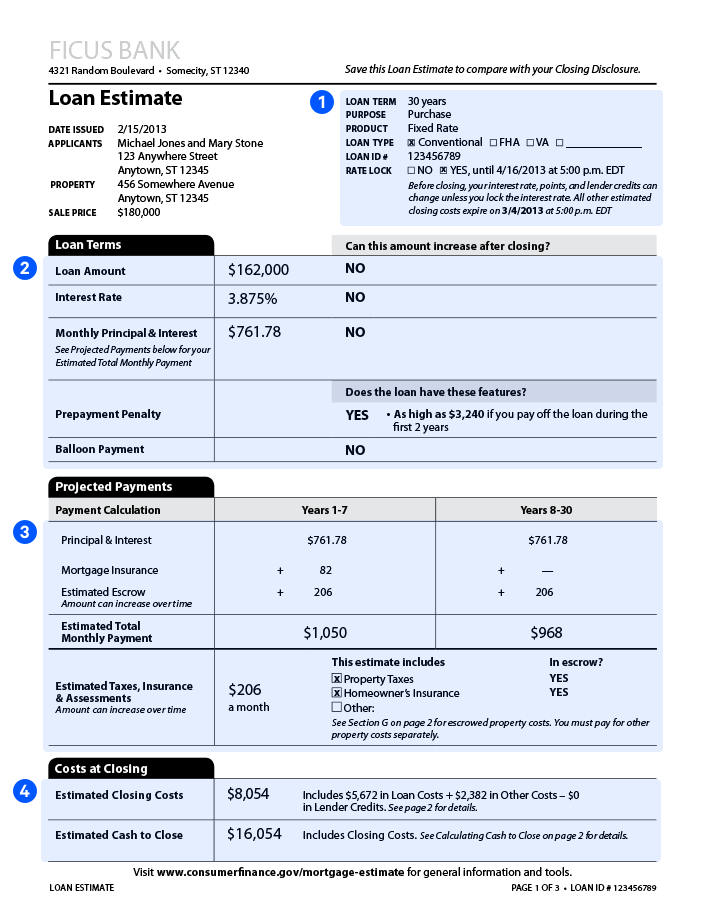
Summary
Page one of the mortgage loan estimate includes a summary of your loan. In the first section, you’ll find the following information:
- Loan term: The number of years it will take you to pay off the mortgage
- Purpose: Whether the loan will purchase or refinance a home
- Product: Whether the mortgage has a fixed or adjustable interest rate
- Loan type: Whether the mortgage is a conventional loan or some other type, such as an FHA or VA loan
- Rate lock: If the lender has locked the interest rate and when that lock expires
Loan terms
The loan terms can be found in the second section, as well as information about whether some of them can change after closing:
- Loan amount: How much you’re borrowing
- Interest rate: The percentage you’ll pay in interest, and whether it’s fixed for the life of the loan or will adjust, and under what terms
- Monthly principal and interest: Your expected total monthly mortgage payment, excluding your homeowners insurance and property taxes
- Prepayment penalty: Stipulates whether your lender charges a fee if you choose to pay off your mortgage before the original loan term ends
- Balloon payment: Stipulates whether there is a large principal payment due when the loan term ends
Projected payments
In the third section, you’ll find a detailed breakdown of your projected monthly payments:
- Payment calculation: This shows the costs that make up your monthly mortgage payment, including principal and interest, and payments toward escrow and private mortgage insurance (PMI), if applicable.
- Estimated total monthly payment: This totals the components that go into your estimated regular mortgage payments.
- Estimated taxes, insurance and assessments: An estimate of how much your homeowners insurance and property taxes will cost, as well as whether they’ll be held in escrow.
Costs at closing
In the fourth section, you’ll find information about the costs you’ll pay on closing day:
- Estimated closing costs: A projected total of your closing costs.
- Estimated cash to close: This includes closing costs, plus any additional money you’ll have to pay upfront — like the down payment — and minus your earnest money deposit, any seller concessions, if buying a home, along with lender credits.
There’s a lot here, but the two big variables from one lender to the next are the interest rate in Section 2 and the closing costs in Section 4. Focus on these two sections when comparing offers.
Loan estimate example: Page 2
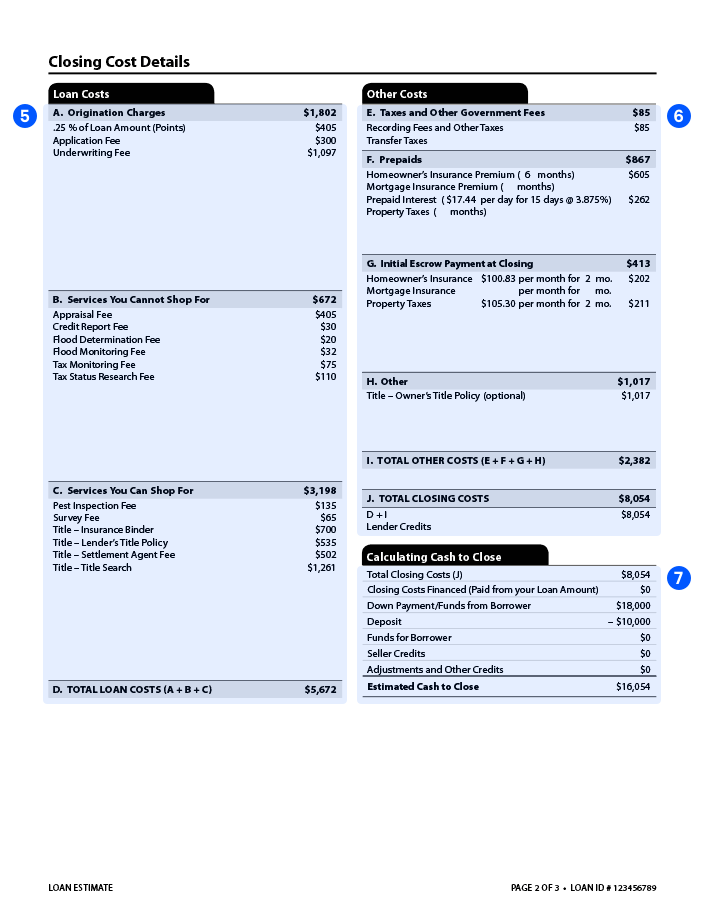
Loan costs
This section offers a detailed list of services related to the creation of your loan and how much you’ll pay for each.
- A: Origination charges: Most lenders charge a fee for initiating the mortgage, which can include fees for the application and other services, plus any mortgage points you’re buying to lower your interest rate.
- B: Services you cannot shop for: This details a series of services you must pay for as quoted to close the mortgage, such as an appraisal and a credit check.
- C: Services you can shop for: You must also pay for these services, such as a property survey and title search, but you can compare providers and potentially lower your costs.
- D: Total loan costs: This is the sum of parts A, B and C.
Other costs
The sixth section details the remaining fees that make up your total closing cost. These include:
- E: Taxes and other government fees: This includes fees for recording the mortgage with the city or county, as well as property transfer taxes, if applicable.
- F: Prepaids: This section explains the amount of your homeowners insurance premiums, mortgage insurance premiums, interest and property taxes that you’ll pay at closing.
- G: Initial escrow payment at closing: You have to pay upfront for the items that will go in escrow, including your initial homeowners insurance premiums and your first property tax installment.
- H: Other: This includes additional, sometimes optional, costs, such as an owner’s title insurance policy.
- I: Total other costs: The sum of parts E, F, G and H.
- J: Total closing costs: The sum of parts D and I.
Calculating cash to close
The final section on the second page of the loan estimate, “Calculating cash to close,” sets out each cost you’ll have to pay at the closing, including the down payment and total closing costs calculated in part J of the estimate document. This is the full estimated amount of cash you’re required to have on hand when you close on your mortgage.
This page is where you can really dig into how closing costs vary from one lender to the next. If one lender offers you the best rate and the lowest closing costs, your decision is easy. But if you receive similar offers, the closing costs can give you a place to negotiate. Don’t be afraid to ask a lender if they can give you a better deal.
Loan estimate example: Page 3
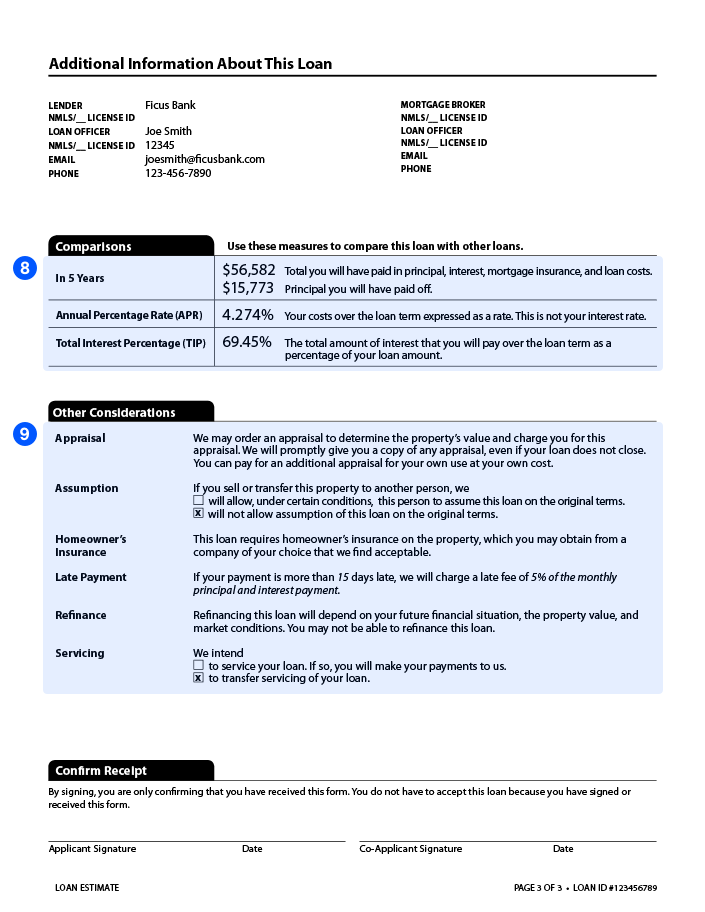
Comparisons
The final page of the loan estimate lists more important details of your mortgage agreement, like the names of the lender and the loan officer. The eighth section also lists three key figures you can use when comparing loan offers:
- Amount of the loan principal you will have paid off after the first five years of your mortgage term, as well as the combined principal, interest and mortgage insurance costs, if applicable.
- The loan’s annual percentage rate, or APR, which is the total cost of your loan expressed as a rate. Because this includes closing costs, among other charges, it will be higher than your interest rate.
- Total interest percentage, or TIP, which is the amount of interest you’ll pay over the term of the loan, calculated as a percentage.
Other considerations
The final page also explains other parts of the mortgage payment process and your responsibilities as the borrower. This spells out, for instance, your appraisal and homeowners insurance requirements, whether the loan can be assumed, any late payment penalties and whether the loan will be serviced by the lender or sold to a separate entity that will service it.
The APR is the key number on page 3 — it’s what should reconcile a low headline rate with the fees underneath it. Look at the five-year cost and TIP figures too; they can look big and scary, but they’re there to help you compare offers, not to discourage you from homeownership.
How to compare mortgage loan estimates like a pro
When comparing offers between mortgage lenders, follow these tips:
- Make sure you’re comparing equivalent offers: check where estimates differ on interest rate, origination charges and points, and confirm you’re comparing each lender’s rate against the same number of points. This also shows you whether a lender with a lower rate is making it up with higher fees.
- Compare the bottom line of the estimated monthly payment and the estimated cash to close.
- Focus on the costs in parts A, B and C: origination charges and fees for the services for which you can’t and can shop around. Even if you’re allowed to find an alternate provider, keep in mind that your lender might have a partnership that includes a preferential rate.
- Note any third-party fees that appear in one lender’s loan estimate and not another’s.
- Look for any lender credits you were promised verbally. If they don’t appear on the loan estimate, ask your loan officer for clarification.
- If you’re refinancing, watch for differences in the loan amount between lenders. If you’re getting a no-closing cost refinance, make sure you understand how those closing costs are accounted for.
Which costs can still change?
Federal rules put a limit on how much certain fees can grow between your loan estimate and your closing disclosure. How much depends on which tolerance category a fee falls into.
| Line item | Can it change before closing? | What that means for you |
|---|---|---|
| Lender, broker and affiliate fees; fees for services you weren’t allowed to shop for; transfer taxes | No | If any of these increase on your closing disclosure, the lender owes you a refund for the difference — ask for it if you don’t see it |
| Recording fees; fees for third-party services you chose from the lender’s list | Only by 10% or less, combined | These can drift a little, but if the total increase across this category tops 10%, you’re entitled to a refund of the excess |
| Property insurance premiums, initial escrow deposits, and services you shopped for on your own | Yes, by any amount | These sit outside the lender’s control, so a jump here isn’t automatically a red flag — but ask if it looks unreasonable |
If you have a “change of circumstances,” the limits no longer apply. These events can include:
- Changing the loan type or down payment amount
- The appraisal comes in higher or lower than expected
- Your credit score changed because you took out a new loan or missed a payment
- Your lender could not document your overtime, bonus or other income
Outside of a documented change in circumstances, if your costs increased beyond these limits, you’re entitled to a refund of the amount above the legal limit. Most borrowers never ask for it.
Frequently asked questions
Why we ask for feedback Your feedback helps us improve our content and services. It takes less than a minute to complete.
Your responses are anonymous and will only be used for improving our website.