Complete costs of buying a house, from down payment to maintenance (and more)


Key takeaways
- Closing costs alone run 2% to 5% of your loan amount, and the lender fees inside that range are the part you can negotiate.
- Ongoing costs — property taxes, insurance, maintenance, utilities and any HOA dues — routinely add hundreds of dollars a month on top of principal and interest.
- The biggest cost most buyers never see is the mortgage rate itself. In 2025, 90% of homebuyers paid more than the best rate available to them, at an extra cost of $3,656 in the first year alone.
Buying a $300,000 home with 3% down means showing up at closing with somewhere between $14,000 and $24,000. Then the bills start: property taxes, insurance, maintenance and utilities, none of which appear on the listing price. Here’s what every stage of a home purchase actually costs, from the cash you need upfront to the expenses that follow you for as long as you own the place.
Home prices in the U.S.
The home price is the biggest single number in the deal. Everything else — your down payment, your loan size, your monthly payment — is based on that figure.
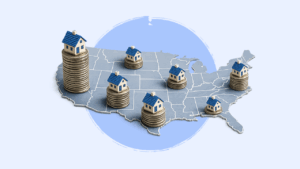
As of October 2026, the most recent data available, the median existing-home price in the U.S. was $416,700, according to the National Association of Realtors. The 0.4% increase from a year earlier marks the 40th consecutive month of year-over-year price increases.
Given these elevated prices, it’s reasonable to wonder whether you should buy a home now or wait. That decision comes down to your finances, your credit and your long-term goals. Prevailing mortgage rates matter too, because a higher rate shrinks what you can borrow at the same monthly payment. The Mortgage Bankers Association predicts that 30-year mortgage rates will remain above 7% throughout 2027.
Don’t try to time the housing market. A home is a long-term purchase, and in a decade, your home should be worth more — maybe significantly so.— Jeff Ostrowski, Principal Housing Market Analyst, Bankrate
“With home prices at record levels and mortgage rates elevated, buying a house can feel scary,” says Bankrate principal housing market analyst Jeff Ostrowski. “Don’t try to time the housing market. A home is a long-term purchase, and in a decade, your home should be worth more — maybe significantly so. If you’re ready to buy and high home prices are the only thing holding you back, my advice is to inhale deeply and make the plunge.”
How much cash do you need to buy a home?
Your required cash to close is your down payment plus your closing costs. On a $300,000 home, here’s how that breaks down by loan type:
- If you’re using a conventional loan with 3% down and your credit score is at least 620, you’d put down $9,000 and borrow $291,000. Closing costs of 2% to 5% add $5,820 to $14,550. Cash to close: about $14,800 to $23,600.
- If you’re using an FHA loan and your credit score is 580 or higher, the minimum down payment is 3.5% ($10,500) on a $289,500 loan. Closing costs add $5,790 to $14,475, and FHA charges an upfront mortgage insurance premium. Cash to close: about $16,300 to $25,000, plus the upfront premium. Below a 580 score, FHA requires 10% down.
- If you’re putting 20% down to skip mortgage insurance, you’d pay $60,000 and borrow $240,000. Closing costs add $4,800 to $12,000. Cash to close: about $64,800 to $72,000.
- If you qualify for a VA or USDA loan, you can put nothing down. Both charge an upfront fee — a funding fee for VA, a guarantee fee for USDA — that can usually be rolled into the loan. Cash to close: about $6,000 to $15,000 in closing costs.
See what you can afford with Bankrate’s home affordability calculator.
Upfront costs of buying a home
Down payment
The down payment is the part of the home’s purchase price you pay upfront, rather than financing it through a mortgage. If you’re buying a $300,000 home and put down 10%, or $30,000, you’d be getting a mortgage for $270,000.
The required down payment is a percentage of the home’s overall price and depends on the type of mortgage loan you get — different loans might require anywhere from 3% to 20% down, and if you’re eligible, some require no money down at all.
Closing costs
Before you get the keys, you’ll need to pay the associated closing costs. These can vary widely but typically range from 2% to 5% of the loan principal. Some of these fees are fixed and some you can shop for, which matters when you get to lowering your total:
- Transfer tax: Most states charge a transfer tax, covering the cost to transfer the title from the seller to the buyer. The amount varies by location and is not negotiable.
- Application and credit fees: Many lenders charge nominal fees to initiate a loan application and check your credit. Set by the lender.
- Origination and underwriting fees: Administrative fees the lender charges to generate and process the loan. An origination fee typically runs 0.5% to 1% of the loan amount — or $1,500 to $3,000 on a $300,000 loan. Negotiable.
- Title fees: Title insurance protects against ownership problems, and a title search company will check property records to confirm there are no liens or other claims against the property. What you pay varies more by state than almost any other closing cost, because many states set title rates by filing rather than leaving them to the market.
- Appraisal fee: A professional appraisal verifies the home’s value and, if you’re financing your purchase, is likely required. Lenders want to ensure the amount they offer doesn’t exceed the property’s value. Set by the lender’s appraisal process.
- Home inspection: Not required for some loan types, but a professional inspection before a deal goes through is highly recommended. It can uncover minor problems before they become major ones. Shoppable, and you choose the inspector.
Other upfront costs
Your down payment and closing costs are the big two, but they aren’t the only money you’ll spend before you move in. Depending on the property, your loan and the terms of your purchase, budget for:
- Earnest money deposit: A good-faith deposit you submit with your offer to show the seller you’re serious. It’s generally applied toward your down payment or closing costs at closing. But it isn’t automatically yours to keep — if you back out of the deal for a reason that isn’t covered by your contract’s contingencies, the seller can keep it. Read your contingency deadlines before you sign.
- Prepaid expenses: You may be required to pay certain costs in advance, including property taxes, homeowners insurance and mortgage interest for the remainder of the closing month.
- Inspections: A standard home inspection doesn’t cover everything. Testing for termites, radon, mold or a septic system is usually a separate charge.
- Government loan fees: FHA loans carry an upfront mortgage insurance premium. VA loans carry a funding fee and USDA loans carry a guarantee fee. All three are a percentage of the loan amount and can usually be financed rather than paid in cash.
Reserves: Cash you keep
Reserves are the one item on this list you don’t spend. They’re the money a lender wants to see sitting in your account after closing, as proof you can keep making payments if something goes wrong.
Whether you need them depends on your loan. Many conventional purchase loans require none from borrowers with strong credit and steady income. Lenders commonly ask for two to six months of mortgage payments on investment properties, multi-unit homes, jumbo loans or applications with a thin credit profile. Ask your lender what your file requires before you commit every dollar you have to the down payment. Assets like stocks and retirement savings generally count toward the total.
“Lenders want to see a cash cushion — they prefer that you not empty out the bank account to cover the down payment and closing costs and then have no money to replace the water heater or repair the air conditioning,” says Ostrowski.
The cost most buyers don’t see: Overpaying on the loan itself
Every cost above shows up on a document you sign. This one doesn’t.
In 2025, 90% of people who bought a home paid a higher mortgage rate than the best one available to them. For the typical purchase borrower, that gap costs $3,656 in the first year and continues for the life of the loan, according to Bankrate’s Hidden Homeownership Tax research.
The best way to close that gap is to shop around and receive quotes from multiple lenders. The first offer you receive is unlikely to be the best available in the market, and the only way you’ll know for sure is to check with other lenders.
Ongoing costs of buying a home
Your purchase price determines whether you can buy. These costs determine whether you can afford to stay.
“The principal and interest are just part of your new financial responsibility. You’ll also have to pay property taxes, homeowners insurance and possibly mortgage insurance,” says Ostrowski. “But the real surprise comes from all the other expenses — lawn care, pest control, maintenance, repairs.”
Mortgage payments
Your monthly mortgage payment will almost certainly be your biggest recurring housing expense, so start your budget there and build around it. On most loans, the payment bundles four things: principal, interest, property taxes and homeowners insurance, plus mortgage insurance if you put down less than 20%. A fixed-rate mortgage locks the principal and interest portion for the life of the loan. The tax and insurance portions can still rise.
Property taxes
Property taxes are usually collected inside your monthly mortgage payment and held in escrow, an account your loan servicer uses to pay the bill on your behalf when it comes due.
The math is straightforward: a home assessed at $400,000 in an area with a 1% tax rate owes $4,000 a year, which adds about $333 to each of your 12 monthly payments.
Keep in mind that your home’s assessed value is not the same as the price you paid for it, or the price you could sell it for. If home values go up in your area, your city or county could assess your home at a higher value, meaning you’ll pay more in property taxes.
Insurance premiums
When buying a home, there are two kinds of insurance to consider.
Most mortgage lenders require a homeowners insurance policy. Costs vary widely, especially in areas at high risk of floods, wildfire or severe weather. Policies are shoppable, so comparing offers from several insurers is one of the easier ways to cut a recurring bill.
The second type is private mortgage insurance (PMI), generally required for conventional loan borrowers who put down less than 20%. PMI can add meaningfully to your payment, but on a conventional loan it eventually ends. Under the federal Homeowners Protection Act, you can request cancellation once your balance reaches 80% of the home’s original value, provided you’re current on payments and the home hasn’t lost value, and your servicer must drop it automatically at 78%.
HOA fees
If you’re buying a condo or any home in a community overseen by a homeowners association (HOA), you’ll likely be required to pay a monthly fee. HOA fees are set by the association and vary widely. These funds cover services the association provides, which may include security, amenities like a pool or gym, landscaping and maintenance. HOAs might also charge occasional special assessment fees for urgent repairs.
Maintenance and upkeep
Plan on spending about 1% of your home’s value on maintenance and repairs each year. On a home at the national median of $416,700, that’s roughly $4,200 a year, or $350 a month. Treat it as a floor rather than a ceiling: older homes and homes with aging roofs, systems or trees run higher. Keep an emergency fund alongside it for the repairs you can’t plan for.
You’ll also pay for basic utilities — water, sewer, gas, electricity and trash. These vary by location and season, and generally the larger the property, the more they cost.
Cost breakdown example
Say you buy at $450,000, close to the national median, and put down 3% — the minimum on many conventional loans if your credit score is 620 or higher. That’s $13,500 down and a $436,500 loan.
At a 7% rate on a 30-year fixed loan, principal and interest run about $2,904 a month. Itemized closing costs come to $11,375, or 2.6% of the loan. If your lender wants two months of reserves, that’s another $5,808 sitting in your account after closing. Total to get in the door: $30,683.
| PURCHASE PRICE: $450,000 | ||
| Down payment | 3% of purchase price | $13,500 |
| Closing costs (2.6%) | ||
| Application fee | $100 | |
| Appraisal fee | $400 | |
| Home inspection fee | $350 | |
| Credit report fee | $150 | |
| Origination fee | $3,275 | |
| Title insurance | $3,000 | |
| Title search fee | $500 | |
| Transfer tax | $3,600 | |
| Reserves | 2 months’ mortgage payments | $5,808 |
| TOTAL UPFRONT COSTS | $30,683 | |
Transfer taxes and title charges vary widely by state, so treat those two lines as a placeholder until you know where you’re buying. Now, let’s look at how your monthly payment breaks down.
| Monthly cost | Amount |
|---|---|
| Principal and interest | $2,904 |
| Property taxes, at a 1% rate | $375 |
| Private mortgage insurance | $167 to $546 |
| Running total | $3,446 to $3,825 |
That’s before homeowners insurance, utilities, maintenance or HOA dues.
The mortgage insurance is required because you put less than 20% down. Annual premiums run 0.46% to 1.50% of the loan amount, according to the Urban Institute’s Housing Finance Policy Center, and the lowest rates go to borrowers with credit scores of 760 or higher. On this loan, that’s $167 to $546 a month — and it’s the one line in the table you can make disappear. Once your balance hits 80% of the home’s original value, you can ask your servicer to drop PMI.
How to lower what you pay
Buying a home comes with plenty of expenses, but several of them are negotiable. Here’s where to start:
- Compare mortgage lenders. Don’t assume your longtime bank will offer you the best deal. Get loan estimates from at least three lenders on the same day and compare the APR, not just the interest rate, since APR folds in the fees. Compare today’s mortgage rates.
- Negotiate the lender’s own fees. Origination, underwriting and application fees are set by the lender, which means they can be reduced or waived — especially if you have a competing loan estimate in hand. This is the single largest piece of closing costs you control.
- Shop the third-party services. You can’t negotiate transfer taxes or the credit report fee, but you can usually choose your own home inspector, title company and homeowners insurer. Your loan estimate marks which services you’re allowed to shop for.
- Ask for seller concessions. Depending on your market, a seller may agree to cover part of your closing costs. Every loan program caps how much a seller can contribute, and on conventional loans, the cap scales with your down payment, so ask your lender for your limit before you write the offer.
- Check first-time homebuyer programs. If you’re buying your first home or haven’t owned one in the past three years, you may qualify for down payment assistance, closing cost grants or below-market loan terms through your state housing agency.
Frequently asked questions
Why we ask for feedback Your feedback helps us improve our content and services. It takes less than a minute to complete.
Your responses are anonymous and will only be used for improving our website.