America’s Affordability Crisis: Excess mortgage costs are holding down borrowers who can least afford it. Here’s what you can do



When Chad Cupp was buying a home in 2022, he couldn’t afford to be picky.
Cupp’s $58,000 income and fair credit were no match for a frenzied housing market that wasn’t kind to anyone with limited financial resources. With the help of his co-signing mother and the FHA loan program, he was fortunate to lock in a 4.75% interest rate on a $280,000 home.
And yet, what looks affordable on paper doesn’t always feel affordable in practice. Cupp is now married. But even with dual incomes, his monthly housing payment, which has risen to almost $2,376, remains a significant financial strain.

“You walk this tightrope all the time,” says Cupp, 47, an electrician in Butte, Montana. “Every month there’s something that is not paid or paid late. There’s just not enough [money] to go around.”
Cupp’s struggle is more than a story about one man who’s stretched too thin. It reflects the broader affordability crisis where buying a home is only half the battle. Even if you can break into the high-rate, high-cost housing market and successfully achieve homeownership, you face another uphill climb: affording your mortgage payments at a time when every other expense in your budget might be rising too.
Housing is the largest burden in American budgets — 34% of the average person’s costs go to it, according to October 2026 BLS data. That leaves less money available for anything else. In fact, 27% of adults say they can’t afford all of their bills, according to recent Pew Research Center data that highlights the affordability challenge millions of Americans faced in 2026.

America's Affordability Crisis
Millions of people are struggling with affordability challenges, and Bankrate is committed to highlighting the causes and the best solutions available.
Read more of our workAdding to that pressure is the Hidden Homeownership Tax, which Bankrate research shows is contributing to 87% of American borrowers overpaying on their mortgages. This surcharge makes homeownership even less affordable, especially for people with lower incomes who are facing a higher-rate environment than Cupp encountered.
For borrowers earning less than $49,000 before taxes, their average overpayment in 2025 was six times higher relative to their income than for borrowers earning $500,000 or more, according to our analysis. And for the largest share of American homeowners — people like Cupp who earn closer to $50,000 or under $199,000 — their overpayment is almost triple that of their highest-earning counterparts.
Cupp, who’s also facing rising property taxes and homeowners insurance premiums, is not alone. Research from the Urban Institute highlights how housing costs have outpaced income growth.
The reality is, the burden of housing affordability isn’t distributed equally: While wealthier Americans have more resources to weather rising homeownership costs, lower- and middle-income homeowners are being crushed by the very asset meant to provide financial security and grow their wealth. Every dollar spent on their mortgages means less money for savings, investments, and just about everything else.
Someone with less income, higher interest rates eats into a larger share of their income than wealthier people. They might be paying a similar [mortgage] rate, but what that represents in terms of their monthly income is going to be vastly different.— JOHN WALSH, RESEARCH ASSOCIATE AT THE HOUSING FINANCE POLICY CENTER AT THE URBAN INSTITUTE
Data: The burden of mortgage overpayment rises as a homebuyer’s income falls
Mortgage overpayment can make homeownership harder to afford for anyone, but the financial burden isn’t just about how much extra borrowers pay in real dollars.
On average, low-, moderate-, and middle-low-income borrowers overpay by $12,580, $18,816, and $30,712, respectively, over eight years, the median period most Americans keep their mortgages. This is much less than the $61,805 paid by high-income borrowers.
Although lower-income families pay less in dollar terms and carry smaller loans on average, these costs take up a larger share of their income.
| Income group | % of mortgage borrowers* | Average applicant income | Average loan amount | Average eight-year overpayment | Annual average overpayment as % of income |
| Low income (<$49K) | 5.19% | $37,211 | $181,255 | $12,580 | 6.06% |
| Moderate income ($50K to $99K) | 30.84% | $76,010 | $255,107 | $18,816 | 2.97% |
| Middle income ($100K to $199K) | 39.98% | $139,780 | $385,224 | $30,712 | 2.78% |
| Upper income ($200K to $499K) | 18.13% | $284,028 | $582,402 | $44,782 | 2.05% |
|
High income (>$500K) |
2.74% | $1,377,184 | $943,541 | $61,805 | 0.99% |
Source: Bankrate analysis of 2025 HMDA data
*Figures don’t sum to 100 because of an unknown percentage in the data
Cupp feels the impact of the overpayment burden every day as his income and high mortgage costs constantly collide. He entered mortgage mitigation twice with his lender to catch up on payments. This includes help from the federal government’s Homeowner Assistance Fund, which saved him from foreclosure twice. His experience comes as more homeowners are facing similar financial pressures. Property data firm ATTOM Data Solutions says foreclosure filings in the first six months of 2026 rose 21% compared to the same time last year.
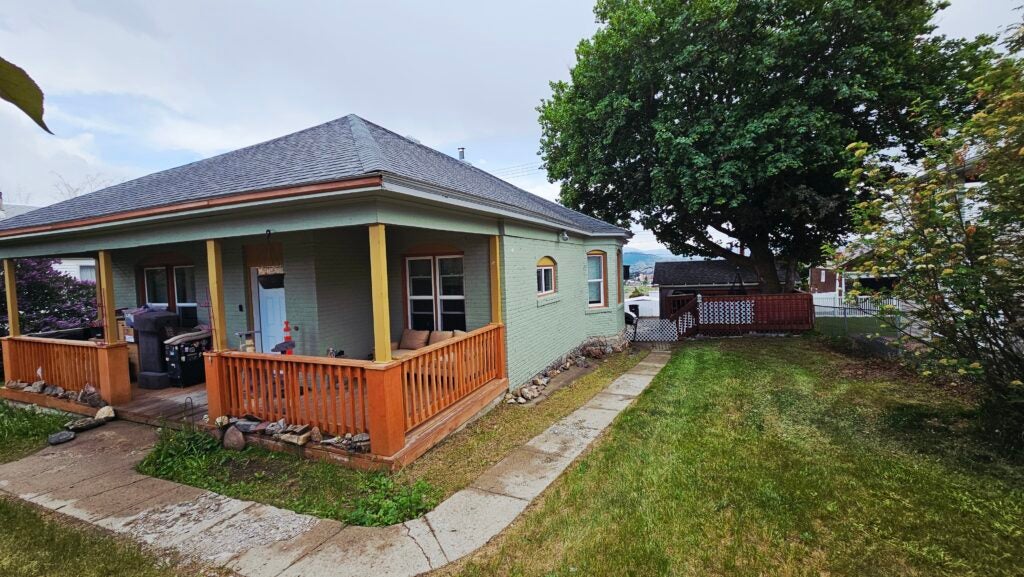
Despite his regrets about buying his home, Cupp vows to do “anything” he can to keep it. The electrician has taken a side job delivering packages for Amazon Flex and fears his wife may soon be forced to do the same. Cupp also enrolled in a payment plan after falling behind on his power bills. The pressure of juggling the mounting obligations also took a toll on his well-being. He says he developed an ulcer because of all the stress.
“I worry about the mortgage every month,” he says. “I worry about being able to pay it.”
The U.S. Census Bureau’s 2025 American Community Survey highlights the widening gap between household incomes, rising housing costs, and families’ ability to afford homeownership. The median percentage of monthly household income spent by people with a mortgage rose 21.9% in 2025. Rising mortgage payments are a major driver of that burden, with the median monthly cost rising to $1,598.
Mortgage repayment hits lower-income borrowers harder in these ways, too
Income is a defining factor in how difficult it is for families to manage housing costs and mortgage overpayment in particular. It’s a simple numbers game: a family with earnings in the low six figures — let alone one earning $49,000 — has considerably less room to absorb an additional housing expense than a family earning more.
The sting of closing costs, down payments
Cupp had second thoughts about buying his home well before the ink dried on his signed mortgage documents. The $280,000 purchase required him to dip into his entire $18,000 in savings, and he still hasn’t recovered financially.
His experience reflects a broader problem. The Pew Research survey shows that more than half (53%) of Americans don’t have rainy-day funds and can’t cover three months of expenses in an emergency. For lower-income families — which Pew defines as having adjusted incomes of less than $50,700 — the percentage rises to 77%. This is at odds with the common-sense advice that we should all have three to six months of expenses tucked away for emergencies. For many homeowners, limited savings can make it even harder to keep up with mortgage payments and unexpected expenses that may crop up.
“I always like to have a $2,000 or $3,000 buffer in my checking account,” Cupp says. “Buying a home really took that away.”
Of all income groups, low-income buyers are stretched the most by upfront mortgage costs. Bankrate’s research found a buyer earning $49,000 or less has to come up with about $5,503 in closing costs when buying a home. This is roughly equal to 14.8% of their annual income, the highest burden of any income group.
| Income group | Average upfront closing fees | Closing fees as % of annual income |
| Low income (<$49K) | $5,503 | 14.79% |
| Moderate income ($50K to $99K) | $6,851 | 9.01% |
| Middle income ($100K to $199K) | $7,996 | 5.72% |
| Upper income ($200K to $499K) | $7,847 | 2.76% |
| High income (>$500K) | $9,380 | 0.68% |
Source: Bankrate analysis of HMDA data
On top of closing costs, there’s the standard 3% to 3.5% down payment ($5,400 to $6,300) on the average $181,255 purchase loan for low-income buyers in 2025, as reported by HMDA. That means a low-income buyer would need to bring roughly $11,000 to $12,000 to closing, equivalent to 30% to 32% of their annual pre-tax income.
“If 30% to 40% of your income is going toward paying your monthly mortgage costs for a lower-income family, that’s the difference between having an emergency amount of money or wherever else they need to put it,” says the Urban Institute’s Walsh.
This problem isn’t exclusive to low-income Americans. Moderate-income buyers ($50,000 to $99,000) surrender a fifth of their pre-tax annual income to obtain the keys to their home, while middle-income buyers ($100,000 to $199,000) must give up about 14% to 15% of their earnings.
The long-term cost of not being able to buy down an interest rate
Lower-income buyers often face a one-two punch when trying to afford a home. Not only may they have a harder time coming up with the down payment and closing costs, but their limited cash can also leave them paying more on their mortgage once they finally get one.
Lower-income buyers who have exhausted their liquid savings to meet closing requirements may have to forgo discount points that could lower their mortgage rate and save them money.
The same buyers may also be forced to accept lender credits to keep their application from being rejected. Lender credits cover some closing costs in exchange for a higher rate. In 2025, nearly 790,000 low-, moderate-, and middle-income borrowers took lender credits, according to Bankrate’s analysis of HMDA data. Although some higher-income homebuyers accept lender credits to preserve cash, for buyers with limited savings, the trade-off can make purchasing a house today possible but increase costs over time.
Our research also found that over the first eight years of homeownership, mortgage interest and fees consume 31.6% of low-income homeowners’ annual gross income, the highest of all income groups. While the percentage drops as incomes rise, the overpayment still eats up a significant portion of the budget for moderate- and middle-income folks.
| Income group | Annual mortgage interest and fees | Percentage of income allocated to debt costs |
| Low income (<$49K) | $11,744 | 31.6% |
| Moderate income ($50K to $99K) | $16,186 | 21.3% |
| Middle income ($100K to $199K) | $24,464 | 17.5% |
| Upper income ($200K to $499K) | $36,637 | 12.9% |
| High income (>$500K) | $58,632 | 4.3% |
For Cupp, the reality of those costs became clear only after he moved into his home.
“You’re just so pumped about being a homeowner,” he says. “Then you have the first mortgage payment, and you don’t really know the gravity of the situation.”
The mortgage insurance penalty behind FHA loans
For lower-income buyers, a FHA loan can be a lifeline in an increasingly expensive housing market. With a 620 credit score that might qualify him for a conventional loan, Cupp believed an FHA loan would give him an even better chance of getting approved for a mortgage. But the same loan program that helped make homeownership possible is the main source of his angst.
According to HMDA data, low- and moderate-income borrowers made up more than half of FHA loan borrowers in 2025. FHA loans are a go-to option for lower-income buyers because of their competitive interest rates, less stringent credit score requirements, and low down payments.
But even with all their perks, FHA loans can make homeownership more expensive over time. It all comes down to two FHA mortgage insurance premiums (MIPs): annual and upfront. Both are designed to protect the lender if you default on the loan.
Annual MIPs are typically paid monthly. If you put down more than 10%, the MIP will automatically drop off after 11 years. But if you put down less than 10%, you can’t get rid of MIP unless you refinance your mortgage or sell your home. An executive order from the Trump Administration in October 2026 directed federal agencies to start a pilot program to proactively cancel mortgage insurance on future loans once borrowers meet the requirements, but no go-live date was announced.
Cupp is constantly reminded of his $180 monthly MIP payment that will stay with him for the life of the loan.
“I should have asked more questions, but it was my first time buying a home, and frankly, I was a fish out of water,” he says.
FHA annual premiums typically range from 0.15% to 0.75% of the loan balance, depending on your loan term, loan amount, and loan-to-value ratio. For a loan of $321,475 — the average FHA purchase loan in 2025 as reported by HMDA — the monthly cost could range from $40.18 to $200.86.
On top of the annual MIP is the FHA loan’s mandatory upfront MIP, which is 1.75% of the loan amount. For that same $321,475 loan, that adds an additional $5,626 charge at closing.
Mortgage insurance premiums are the reason FHA loans cost nearly twice as much at closing as conventional loans ($11,954 vs. $6,264, a $5,690 difference), according to Bankrate’s analysis. While you can pay the full amount at closing, nearly all FHA borrowers roll upfront MIPs into their loan balance. This not only increases the amount they owe but also the interest they pay over time.
“A lot of people wrongly think that at least it gets rolled into the loan most times, so ‘it doesn’t really affect me,’” says Alan Silber, a longtime mortgage broker in South Carolina. Silber points out that for someone putting down 3.5%, the cost of MIP could add up to nearly as much as the down payment, depending on the purchase price of the home.
The result? FHA loan or not, homeowners who already earn less may be forced to make financial sacrifices in areas like saving for retirement, building an emergency fund, or paying down debt.
“If you max out a mortgage, even though you are qualified, all these other things are going to take a hit over time,” adds Silber.
The equity drain happening behind the scenes
How to keep your mortgage from eating up a burdensome share of your income
While 87% of homeowners overpay on their mortgage, the stakes are simply higher for lower-income borrowers. There are steps you can take to lessen the blow, and your options depend on where you find yourself in the process.
If you are thinking about buying a home
Don’t let FOMO drive a six-figure decision: If you are concerned that mortgage rates may keep rising as they have in 2026, that shouldn’t be the reason you rush to buy a home now. Before buying, plug in your information into a home affordability calculator. Make sure you can still afford your home even if you lose your income or if property taxes, homeowners insurance, or other expenses rise. If your circumstances are shaky, it might make sense to pause your search and commit to shoring up your finances.
Shop around for your mortgage: When money is tight, your mortgage takes up a large share of your monthly income, and it also impacts what you can afford. Avoid overpaying by shopping around and comparing multiple lender offers. Get at least three quotes from a mix of banks, credit unions, and online lenders. Compare the loan estimates side by side, and ideally on the same day, to help you make an informed decision.
Ask lenders to lay out your options: Don’t assume a specific loan type might be better for you. A loan officer won’t necessarily compare the total costs of a conventional, FHA, or VA loan (if eligible) unless you ask. For example, Fannie Mae HomeReady and Freddie Mac Home Possible loans only require 3% down and $0 in upfront mortgage insurance fees. The biggest purchase you will likely ever make deserves more than a quick “yes.”
Look at the short- and long-term costs: Don’t get roped in by a lower monthly payment, which can sometimes mean paying more over the life of the loan. Look beyond the advertised rate and compare the APR (total cost of the loan), plus closing costs and other fees. How much you will pay over time in interest and other costs should factor into your decision-making. Don’t forget to factor in property taxes, homeowners insurance, and contributions to your emergency fund. Use a mortgage calculator to figure out how much you can comfortably afford.
A rule of thumb is that you shouldn’t spend more than 28% of your gross monthly household income on housing costs. If you have additional debt, your housing costs and debt can be bumped up to 36% of your gross income. But don’t let a rule dictate your finances. Only you know if you can handle all of your expenses, even if your costs fall below the threshold.
Utilize state & local housing assistance: State housing finance agencies are located in every state. They offer down payment assistance, including grants, forgivable loans, and zero- or low-interest second mortgages specifically designated for low-income homeowners. The Department of Housing and Urban Development (HUD) can connect you with a HUD-approved housing counselor for free or little cost, who can help you review your mortgage and explain your options.
If you have already bought your home
Contact your lender to discuss mortgage mitigation options: If you are struggling with your payments, don’t be afraid to reach out to your servicer. Depending on your financial circumstances, you may have options, including a mortgage forbearance or loan modification.
Refinance only if it makes sense: Refinancing your mortgage replaces your current mortgage with a new one and could help you lower your rate, make your monthly payments more affordable, remove private mortgage insurance, or change your loan terms. Make sure you run the numbers through a refinance calculator to figure out if the benefits outweigh the costs. Be cautious to avoid forfeiting a low, COVID-19-era interest rate, for example, unless absolutely necessary, as it can significantly increase your monthly payment and overall cost of repayment.
Look into mortgage assistance programs: Seek help early if your payments become difficult. Depending on where you live, non-profits and government agencies may offer free help with property taxes or other housing-related costs. A HUD-approved housing counselor can help you review your budget and identify potential assistance programs.
Even with options available to make mortgage payments more manageable, keeping up with the cost of homeownership can still be challenging. Cupp has benefited from mortgage mitigation but hasn’t pursued other options that might help ease the strain of his expensive mortgage. While he’s grown to love his three-bed, one-bath home, he wishes he’d understood the full costs of homeownership before buying.
“I absolutely would not do it again,” he says. “It’s difficult, and I know I’m not the only one out here struggling.”
Why we ask for feedback Your feedback helps us improve our content and services. It takes less than a minute to complete.
Your responses are anonymous and will only be used for improving our website.